



David J. Danto
Travel thoughts in my
own, personal opinion
eMail: ddanto@IMCCA.org Follow Industry News: @NJDavidD on 

What Goes Up Must
Come Down. Unless It’s an Airfare. March 2026
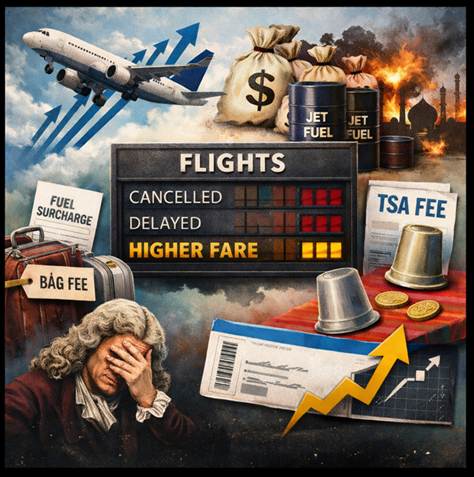 There’s an old expression that says what goes up must come down. In most corners of life, that still holds. Gravity works. Bubbles burst. Trends fade.
Even the airplanes themselves, thankfully, do in fact come back down.
There’s an old expression that says what goes up must come down. In most corners of life, that still holds. Gravity works. Bubbles burst. Trends fade.
Even the airplanes themselves, thankfully, do in fact come back down.
But in the airline industry, that law seems to apply only to
the physical metal. The planes come down. The prices do not.
I was thinking about that this week when I rushed to buy my
own airfare to a conference I need to attend this June. Newark to Las Vegas, round trip, at
reasonable times, came to $429 all in. In
today’s travel environment, that almost felt merciful. Not a great deal, exactly, but at least
something in the range of civilized. So,
I bought it, because I have seen this movie before, and I know how these
stories go. If we check that same
itinerary again in a week, there is a very good chance it will not still be
that same price.
And no, that is not because the flight suddenly got better. The seat will not be wider. The boarding process will not be less
dehumanizing. The gate area will not
transform into a private club with passed hors d’oeuvres and a string quartet. It will just cost more, because somewhere in
the distance there is another crisis, another excuse, another “temporary”
market adjustment that somehow manages to become permanent with breathtaking
speed.
This time, of course, the excuse is not hard to find. There is now a war expanding in the Middle
East, with regional players getting dragged into the orbit of the conflict. While the real collateral damage to the
region is sadly likely to be significant, anyone who has flown more than twice
in the last twenty years knows exactly what comes next at the airlines. The price of fuel goes up. Airlines start to feel “pressure.” Analysts
begin talking about fare increases. Revenue
management teams get that warm, familiar glow.
And before long, ticket prices start creeping upward.
What is especially rich about this routine is that these
increases are never initially presented as the greed they are – we’re told they
are a necessity, of course. Fuel
surcharge. Security surcharge. Facility charge. Segment fee.
Recovery fee. Call it whatever
you want. The names change, but the
trick stays the same. A new cost gets
introduced or highlighted, travelers are told it is regrettable but
unavoidable, and the increase gets baked into the cost of flying.
Then the original reason weakens or disappears, and the
higher price remains anyway.
That has been one of the airline industry’s greatest talents
for decades. Not flying, mind you. Not
boarding. Not operational transparency. Heaven knows, not customer service. No, their great genius has been in taking
supposedly temporary increases and turning them into permanent features of the
landscape.
Take the Passenger Facility Charge. That one showed up in the early 1990s and was
sold as a way to help airports fund improvements. Fine. Then
there are the federal segment taxes, which keep inching along and quietly
adding up. After 9/11 came the security
fees, which were understandable in context, but like everything else in
aviation, once they were in place they never developed any urge to leave. In fact, they evolved, expanded, and settled
in like a relative who said they were only staying for the weekend, then
quietly filled out change-of-address cards.
Then there were the airline-invented charges.
The fuel spike era of 2008 was one of the clearest examples. Oil prices went wild, airlines threw fuel
surcharges onto tickets, and the industry made a great theatrical production
out of how impossible it had all become.
At the same time, checked bag fees started appearing and spreading
across the majors, supposedly as part of coping with higher fuel and operating
costs. Travelers were told, implicitly
or explicitly, that the world had changed and these new charges reflected harsh
realities.
Then fuel prices came down.
Did the new fees disappear? Of
course not.
Did airlines turn around and say, good news everybody, the
emergency has passed and we’re restoring the old model? Please.
They kept the fees, normalized them, and then built entire financial
expectations around them. What began as
a reaction became a revenue stream. That
is the pattern every time. The crisis
may be temporary. The monetization never
is.
That is why I laugh every time someone treats the latest
price increase as if it is a brief weather event. In the airline business, there is no such
thing as a temporary fare increase once the market proves it will tolerate it. The separate surcharge may vanish. The language may soften. Regulators may require the all-in fare to be
shown more clearly. But the money does
not go away. It just gets folded into
the base fare, hidden in another bucket, or quietly accepted as the new normal.
The shell game is the whole business model. They just keep moving the charge around and
hoping you’ll mistake relocation for removal.
And that is why I rushed to buy my June ticket, then checked
the rest of my travel calendar to see what else I should pre-buy before the
next round of increases hits.
The next few days are likely to bring a wave of higher
pricing driven by fuel concerns, geopolitical instability, and the usual
industry instinct to charge first and explain later. Once that increase works its way into the
system, it is not coming back out just because the headlines or crude oil
prices eventually calm down.
That is the part travelers need to understand. The airline industry has trained us to think
in terms of events, but prices live in memory.
The war happens now. Oil spikes
now. Fares rise now. But when oil settles, when the route network
adjusts, when the talking heads move on to the next crisis, the customer rarely
sees a neat reversal. The industry has
already learned that people will pay the higher fare or the added fee, and once
that lesson is learned, it tends to stick.
If Sir Isaac Newton had spent more time in airline terminals,
he might have updated the law. What goes
up must come down, unless it has been touched by airline accounting. Then it goes up, gets justified in a press
release, and remains suspended in the atmosphere forever.
At this point, the only thing in commercial aviation that
reliably comes down is the aircraft. The
rest of it just hovers above your wallet.
So, if you have travel coming up and you know you are going,
buy the ticket. Buy it now, before the
latest round of fuel panic and geopolitical uncertainty gets fully digested
into the fare structure. Because once
the airlines decide they have found a new altitude for pricing, they are not
exactly known for descending gracefully.
Planes land.
Airfares don’t.

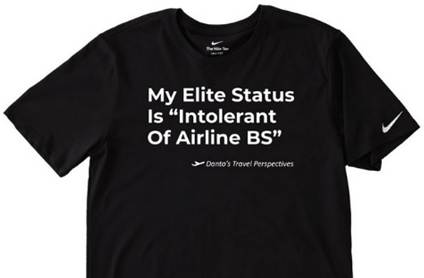 After decades of candid travel
commentary – from loyalty program “magic tricks” to hotel check-in roulette – I’ve
decided to turn some of that honesty into apparel. These aren’t novelty shirts; they’re the
exact truths every road warrior wishes they could say out loud. Whether you’re quietly muttering “My
loyalty points devalued while you read this shirt” or admitting “If
delays build character then I’m the whole movie’s
cast” you’ll find plenty of familiar sentiments… and more. Everything is
produced by a reputable outfit, with black tees that work under a sport jacket
plus hoodies and wicking travel gear for life on the road. The site also has my
honest and snarky takes on technology trade shows. Take a look at Tinyurl.com/TechAndTravelWear. Even if you’re not buying
they’re fun to read and commiserate – and if you do buy something, maybe I’ll
break even. If you want a style you
don’t see, just email me and I’ll add it.
After decades of candid travel
commentary – from loyalty program “magic tricks” to hotel check-in roulette – I’ve
decided to turn some of that honesty into apparel. These aren’t novelty shirts; they’re the
exact truths every road warrior wishes they could say out loud. Whether you’re quietly muttering “My
loyalty points devalued while you read this shirt” or admitting “If
delays build character then I’m the whole movie’s
cast” you’ll find plenty of familiar sentiments… and more. Everything is
produced by a reputable outfit, with black tees that work under a sport jacket
plus hoodies and wicking travel gear for life on the road. The site also has my
honest and snarky takes on technology trade shows. Take a look at Tinyurl.com/TechAndTravelWear. Even if you’re not buying
they’re fun to read and commiserate – and if you do buy something, maybe I’ll
break even. If you want a style you
don’t see, just email me and I’ll add it.
This article was written by David Danto and contains solely his own, personal
opinions.
All image and links provided above as reference under
prevailing fair use statutes.
Copyright 2026 David Danto
++++++++
As always, feel free to write and comment, question or
disagree. Hearing from the traveling
community is always a highlight for me.
Thanks!