



David J. Danto
Travel thoughts in my
own, personal opinion
eMail: ddanto@IMCCA.org Follow Industry News: @NJDavidD on 

What’s In A Seat? March 2026
Or, as Shakespeare
put it, a chair by any other name would still stink if somebody bolted it onto
an airplane.
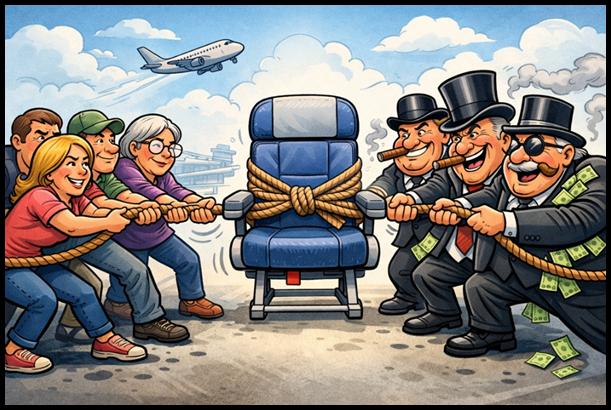 Airlines and passengers have been fighting over the chair for decades, even when the airlines
pretend they are fighting over schedules, routes, fares, or customer service. The chair is where the argument actually
lives. It is the product. It is the commodity. It is the source of discomfort, resentment,
tiny victories, and occasional travel rage.
It is where the airline makes its money and where the passenger feels,
literally, what that money bought.
Airlines and passengers have been fighting over the chair for decades, even when the airlines
pretend they are fighting over schedules, routes, fares, or customer service. The chair is where the argument actually
lives. It is the product. It is the commodity. It is the source of discomfort, resentment,
tiny victories, and occasional travel rage.
It is where the airline makes its money and where the passenger feels,
literally, what that money bought.
We have been arguing for years about how much space should
exist between one chair and the next. Pitch,
width, recline, legroom, tray table intrusion, whether your knees touch the
seat in front of you before the plane even leaves the gate – these are not
details. These are the lived experience
of flying. Airlines know that every inch
matters. Passengers know that every inch
matters. The difference is that airlines
see inches as revenue opportunities, while passengers experience them as permitting
blood circulation.
There was a time when at least one airline made the case that
better chairs could be good business. American
Airlines had its More Room Throughout Coach initiative, better known as MRTC. The theory was simple enough: if you make
economy more comfortable, customers will reward you for it. It was one of those rare moments in airline
history when a carrier briefly flirted with the radical notion that a better
product might have value all by itself.
That experiment did not last.
Why would it? The industry
learned a different lesson. Airlines do
not necessarily need to make the product more comfortable if they can keep load
factors artificially high, reduce capacity, manage supply tightly, and ensure
that many flights go out full or nearly full.
In that environment, discomfort is not a bug. It is part of the model. If customers keep buying anyway, the
incentive is not to create more room throughout coach. The incentive is to figure out how many more
chairs can be squeezed into the same metal tube before the public finally
revolts. And since the public has not
revolted in any meaningful or sustained way, here we are.
United still sells Economy Plus, and other carriers have
their own versions of “premium-not-premium” seating. That is the airlines’ modern answer to the
comfort problem: make the base product worse, then upsell a partial solution to
the worsening the airline itself created.
This is not innovation. It is
monetized relief. But even that does not
get at the more interesting question, which is not how big the chair is, but
who actually owns it.
That question sounds silly until you fly enough to know it
isn’t.
If I buy a ticket, select a seat, perhaps even pay extra for
that seat, and book specifically because I want a certain spot on a certain
aircraft, do I own that chair in any meaningful sense? Common sense says yes. Airline logic says absolutely not. The contract of carriage is the airline’s
favorite scripture, and it is always ready to be quoted when things go wrong. In most cases, what the airline is promising
is transportation from Point A to Point B.
That is the obligation. The rest
of it – the timing, the experience, the specific seat, the equipment type, the
dignity – is often treated as conditional, flexible, and largely at the
airline’s discretion.
Passengers, of course, do not behave as though the seat is
incidental. Nor should they. People choose seats for all sorts of
legitimate reasons. An aisle seat may
matter because of mobility concerns or simple comfort. A window seat may matter because the
passenger wants to sleep without being climbed over twice during the flight. Some people want to be near the bathroom. Some want to be nowhere near it. Some want to deplane quickly for a connection. Some want to sit next to a spouse. Some want very much not to. These are not frivolous preferences. They are part of how people manage the ordeal
of air travel.
That is why the onboard seat-switching drama is so irritating. A family boards and wants to sit together. A parent asks someone to move. Maybe the requested swap is reasonable. Maybe it is not. Maybe the person being asked gave real
thought to selecting that seat and does not want to surrender it just because
somebody else failed to plan or assumed social pressure would do the work. The passenger who says no is often treated as
selfish, as though the airline seating chart were a moral exercise rather than
a commercial transaction. But the
passenger who planned ahead is not the villain.
The system is.
Still, even that familiar argument is only half the story. The newer insult is not when another
passenger wants your seat. It is when
the airline decides, all by itself, that the seat you selected is no longer
yours.
That happened to my wife and I this past week.
We booked end of summer travel well in advance, with aisle
seats apart from each other in row 10, exactly where we wanted to be. That was not random. We chose those seats for multiple reasons,
like experienced travelers do. Then
there was a schedule change. Not a
dramatic one. Not a different aircraft
type. Not a merged flight. Not a cancellation that forced a rebooking
onto some completely different configuration.
This remained, as far as I could tell, the same 737 MAX 8 with the same
general seating layout. The airline
changed the flight number and nudged the timing around by about an hour. Yet somehow, after that change, our seats
vanished and we were moved back to row 15, the limited-reclining row in front
of the exit rows.
That is not a minor change.
That is a product downgrade, even if the airline does not classify it as
one. We do not recline our seats on
airplanes because, in our view, it is simply rude to do that to the person
behind us. But if we happen to get stuck
behind a “criminal serial recliner” who slams back into our space the
moment the plane takes off, then in a limited-recline seat there is very little
we can do to cope with it.
Now, if an airline takes you out of first class or paid
premium economy and moves you down, then yes, some compensation is generally
due. But if it merely takes away the
specific economy seat you deliberately chose and dumps you somewhere worse, the
airline’s answer is often a shrug wrapped in contractual language. They are allowed to do it. They will tell you they are allowed to do it. What they generally will not tell you is why.
So I called United.
I did not call because I thought they lacked the contractual
right. I called because the move made no
sense. There was no obvious operational
explanation. Same aircraft configuration. Same seating logic. No visible reason for row 10 to be
unavailable other than that somebody, somewhere, decided somebody else should
have it instead. United, predictably,
would not provide any meaningful explanation.
They simply reverted to the general rule that seat assignments are not
guaranteed.
And this is where the issue gets interesting, because opacity
changes the story. If they had changed
aircraft types, fine. If they had
consolidated flights, annoying but understandable. If a federal air marshal needed a specific
position, that has happened before in first class and at least it has a reason. But when nothing visible has changed except
that the flight suddenly looks nearly full months in advance and the seats you
selected have disappeared, suspicion naturally follows. Did a group block come in? A cruise package? An aggregator? A bulk booking with preferred seat
allocations? I do not know. United certainly is not going to tell me. But when a seat reassignment has no
operational explanation and benefits someone else at your expense, it is hard
not to conclude that the chairs are being re-traded behind the curtain. My only recourse is to pick new flights or
ask for a refund. Neither is much of a
remedy when the flights you actually wanted were the ones you booked in the
first place. Damn.
So, as Rodgers and Hammerstein taught us, in looking at the
parameters of an aircraft seat, that will bring us back to dough – in this
case, the dough charged for the chair.
What is a seat, really?
The airline wants it to be treated as incidental when that is convenient
for them, and as premium real estate when it wants to charge for it. That is the contradiction at the heart of the
modern airline cabin. An airline seat is
valuable enough to upsell, auction, reserve, zone, prioritize, and subdivide
into branded tiers, but supposedly not important enough for the airline to
guarantee it once you have selected one.
The chair matters very much when they are monetizing it, and barely at
all when they are taking it away. In
fact, United is currently fighting in court over claims that it sold certain
seats as “window seats” on aircraft where those seats do not actually have
windows, with them just against a windowless section of the interior wall of
the plane. So clearly, the seat matters
very much when the airline wants to market and monetize it, but apparently much
less when the issue is the passenger’s comfort or expectation.
Logic dictates that you cannot have it both ways. But when have U.S. airlines ever been
constrained by logic?
If seat selection is part of the selling proposition, then it
should carry some integrity. If I am
shown a map, asked to choose, and perhaps nudged to pay more for better
positioning, then that choice should mean something. It does not have to mean the impossible. Operational realities exist. Aircraft swaps happen. Flights get disrupted. Safety and regulatory issues override
preference. Fine. But absent those conditions, the seat should
not be treated as a revocable suggestion.
At the very least, when an airline changes it, the passenger deserves a
clear explanation.
That is especially true because the chair is not just
furniture. It is experience. It is comfort. It is access.
It is planning. It is the
difference between a tolerable trip and an irritating one. It is where your laptop opens or does not. It is whether your knees ache, whether your
back survives, whether you can get up without stepping all over two strangers,
whether you can see the wing, whether your spouse is nearby, whether the person
in front of you can recline into your lunch, or simply into your oxygen space. The airline may see it as an interchangeable
unit of inventory. The passenger
experiences it as the trip itself.
There is also a broader truth here. Airlines have spent years stripping away
assumptions of ownership from the flying experience. You no longer really own the fare you thought
you bought if the airline can change the schedule materially and still treat it
as normal. You do not own overhead bin
space. You certainly do not own the
timing in any durable sense. And
increasingly, you do not seem to own the chair either, even when you picked it
first, picked it carefully, and paid for it.
So what’s in a seat?
Quite a lot, actually.
There is the physical seat, which has been shrinking or at
least feeling smaller for years. There
is the monetized seat, sold back to you in slightly less awful versions. There is the moral seat, the one strangers
expect you to surrender because they failed to reserve properly. And there is the phantom seat, the one you
thought you had until an airline quietly decided otherwise and reminded you
that your reservation was more aspiration than entitlement.
The chair tells the story of modern air travel better than
almost anything else. It is smaller than
it used to be, more valuable than it used to be, less secure than it used to
be, and somehow still treated by the airlines as though it should not matter
very much to the person sitting in it.
But believe me, to both passengers and the bean-counters at
the airline, it matters. And if that
chair is important enough to sell, it should be important enough to honor.

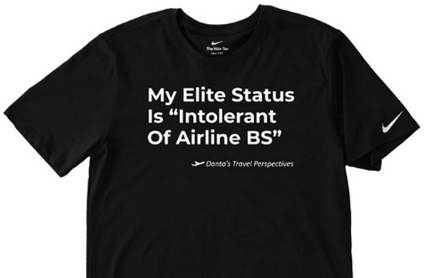 After decades of candid travel
commentary – from loyalty program “magic tricks” to hotel check-in roulette –
I’ve decided to turn some of that honesty into apparel. These aren’t novelty shirts; they’re the
exact truths every road warrior wishes they could say out loud. Whether you’re quietly muttering “My
loyalty points devalued while you read this shirt” or admitting “If
delays build character then I’m the whole movie’s cast” you’ll find plenty
of familiar sentiments… and more. Everything is produced by a reputable outfit,
with black tees that work under a sport jacket plus hoodies and wicking travel
gear for life on the road. The site also has my honest and snarky takes on technology
trade shows. Take a look at Tinyurl.com/TechAndTravelWear. Even if you’re not buying they’re fun to read
and commiserate – and if you do buy something, maybe I’ll break even. If you want a style you don’t see, just email
me and I’ll add it.
After decades of candid travel
commentary – from loyalty program “magic tricks” to hotel check-in roulette –
I’ve decided to turn some of that honesty into apparel. These aren’t novelty shirts; they’re the
exact truths every road warrior wishes they could say out loud. Whether you’re quietly muttering “My
loyalty points devalued while you read this shirt” or admitting “If
delays build character then I’m the whole movie’s cast” you’ll find plenty
of familiar sentiments… and more. Everything is produced by a reputable outfit,
with black tees that work under a sport jacket plus hoodies and wicking travel
gear for life on the road. The site also has my honest and snarky takes on technology
trade shows. Take a look at Tinyurl.com/TechAndTravelWear. Even if you’re not buying they’re fun to read
and commiserate – and if you do buy something, maybe I’ll break even. If you want a style you don’t see, just email
me and I’ll add it.
This article was written by David Danto and contains solely his own, personal
opinions.
All image and links provided above as reference under
prevailing fair use statutes.
Copyright 2026 David Danto
++++++++
As always, feel free to write and comment, question or
disagree. Hearing from the traveling
community is always a highlight for me.
Thanks!