



David J. Danto
Travel thoughts in my
own, personal opinion
eMail: ddanto@IMCCA.org Follow Industry News: @NJDavidD on 

When Marketing
Reminds Me Why I Left August 2026
 Companies spend enormous amounts of money trying to keep their brands in front of
customers. They send emails, postcards, catalogs, app notifications, loyalty offers,
limited-time promotions, and increasingly desperate reminders that some
supposedly irresistible opportunity is about to disappear.
Companies spend enormous amounts of money trying to keep their brands in front of
customers. They send emails, postcards, catalogs, app notifications, loyalty offers,
limited-time promotions, and increasingly desperate reminders that some
supposedly irresistible opportunity is about to disappear.
The theory is simple: keep reminding customers how
wonderful you are, and eventually they will purchase something.
There is just one flaw in that strategy. Sometimes the
customer already knows exactly who you are.
When a company has disappointed me, broken a promise,
refused to take responsibility, or hidden behind fine print, its marketing does
not erase the experience. It refreshes my memory of it. Every new sales pitch
becomes another reminder of why I no longer want to do business with that
company.
United Airlines emails me at least four times a week.
There is always another mileage promotion, credit card offer, vacation package,
seat upgrade, shopping portal, dining program, or elaborate game that promises
to reward me for behaving exactly as United would like me to behave.
The offers frequently amount to something like this: register
for a promotion, purchase nine overpriced things within three months, carefully
follow several pages of rules, and receive 4,000 bonus miles.
You want me to do what, for what?
Perhaps someone at United believes these promotions
create loyalty. They may create activity among less savvy customers who enjoy
chasing offers or who have not done the math. But they do not create loyalty in
me. They remind me that airline miles have become a largely imaginary currency whose
value, availability, and redemption rules can be changed whenever the airline
chooses.
I spent many years going out of my way to remain loyal
to their airline. I booked less convenient flights, accepted connections, paid
higher fares, and arranged travel around loyalty programs because I believed
the relationship had value. The airlines gradually taught me otherwise, and
brought the final hammer down when the million-miler program was intentionally crippled.
Now, every email asking me to jump through another
series of hoops for a handful of miles reinforces the lesson. I am never again going
significantly out of my way to book an airline merely to earn points that the
airline can devalue after I earn them.
United believes it is reminding me to purchase. It is
actually reminding me not to care.
Holland America is providing a similar service.
I recently wrote
about a terrible experience on a Holland America cruise involving an
excursion that was nothing like it had been presented. Holland America marketed
the excursion, sold it to us, charged us for it, and delivered us to the
third-party operator. When we asked the cruise line to take some responsibility
for what had happened, its response was essentially that the fine print
protected it and the excursion had been operated by someone else.
That may be a defensible contractual position. It is
an awful customer relationship position.
Since then, Holland America has continued sending me
promotional emails every few days. Come aboard another cruise. Receive a complimentary
room upgrade. Get free drinks. Get free dining. Get free casino money. Book
quickly because this remarkable offer will supposedly disappear at midnight,
presumably just before an almost identical offer appears the next morning.
I doubt anyone at Holland America understands what
those emails accomplish.
They do not make me picture a beautiful ship sailing
through Alaska. They make me remember the excursion. More importantly, they make
me remember the company’s refusal to stand behind something it sold.
The original problem was disappointing. The response
was the part that damaged the brand.
That distinction seems to be lost on many companies.
Mistakes happen. Products fail. Flights are delayed. Hotel rooms are not ready.
Excursions disappoint. Restaurants serve bad meals. Orders arrive damaged.
Customers generally understand that no company can deliver perfection every
time.
What customers remember is what happens next.
Does the company listen? Does it acknowledge the
problem? Does it attempt to make the customer whole? Does someone use judgment
and say, “Regardless of what the fine print allows us to do, this is not how we
want a customer to feel about our company”?
Or does it send a form letter, cite a policy, blame a
contractor, and then return the customer’s email address to the marketing
department so the next promotion can arrive on schedule?
Companies appear willing to spend endlessly to acquire
customers while treating the cost of preserving an existing relationship as an
intolerable expense. They will pay for advertisements, marketing automation,
loyalty platforms, customer data systems, direct mail, promotional discounts,
social media campaigns, and armies of consultants studying brand perception.
But when an actual customer asks them to stand behind
what they sold, suddenly every dollar matters. There is seemingly no
communication nor linkage between these customer support interactions and the companies’
marketing activities.
That is backward.
A company should spend less time reminding me that it exists
and more time giving me a reason to be glad that it does.
Marketing cannot repair a relationship that customer
service has abandoned. A discount does not restore trust. Bonus points do not
create loyalty. A “free” beverage package does not make a company accountable.
Sending the same customer more messages does not make the previous experience
disappear.
In fact, the more frequently the messages arrive, the
more frequently the customer is invited to reconsider the brand.
Sometimes that works exactly as intended. Sometimes
the customer remembers a pleasant experience and books again.
But sometimes the email arrives and the customer
thinks, “Oh yes. Those are the people who burned me.”
That is the risk companies seem unwilling to
recognize. Brand awareness is not automatically positive. Staying at the top of
a customer’s inbox is not useful when the company also occupies the top of that
customer’s list of organizations to avoid.
A brand is not what appears in the advertisement. It’s
what the customer remembers when the advertisement arrives.
United Airlines can send me four emails tomorrow.
Holland America can offer me another “free” cruise package. Other companies can
continue stuffing my mailbox and filling my inbox with carefully targeted
reminders.
But when the last meaningful interaction involved
disappointment followed by indifference, the targeting works in reverse.
They are not reminding me to come back.
They are reminding me why I left and would never trust
them again.

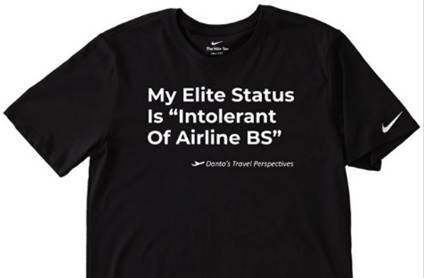
After
decades of candid travel commentary – from loyalty program “magic tricks” to
hotel check-in roulette – I’ve decided to turn some of that honesty into
apparel. These aren’t novelty shirts;
they’re the exact truths every road warrior wishes they could say out
loud. Whether you’re quietly muttering “My
loyalty points devalued while you read this shirt” or admitting “If delays
build character then I’m the whole movie’s cast” you’ll find plenty of
familiar sentiments… and more. Everything is produced by a reputable outfit,
with black tees that work under a sport jacket plus hoodies and wicking travel
gear for life on the road. The site also has my honest and snarky takes on technology
trade shows. Take a look at Tinyurl.com/TechAndTravelWear. Even if you’re not buying they’re fun to read
and commiserate – and if you do buy something, maybe I’ll break even. If you want a style you don’t see, just email
me and I’ll add it.
This article was written by David Danto and contains solely his own, personal
opinions.
All image and links provided above as reference under
prevailing fair use statutes.
Copyright 2026 David Danto
++++++++
As always, feel free to write and comment, question or
disagree. Hearing from the traveling
community is always a highlight for me.
Thanks!