



David J. Danto
Travel thoughts in my
own, personal opinion
eMail: ddanto@IMCCA.org Follow Industry News: @NJDavidD on 

Pickpocket Pricing April 2026
Or, When Airlines
Offer You “Choice,” Watch Your Wallet
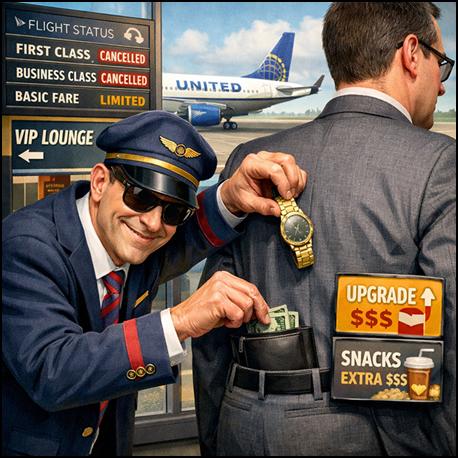 There are two ways an airline can
raise prices. One way is blunt and honest. The other is dressed up in marketing
language, smiling pleasantly and complimenting you while it lifts your watch
and picks your wallet out of your pocket.
There are two ways an airline can
raise prices. One way is blunt and honest. The other is dressed up in marketing
language, smiling pleasantly and complimenting you while it lifts your watch
and picks your wallet out of your pocket.
One way is direct. It
tells you plainly that something now costs more than it did before. Nobody enjoys it, but at least it has the
decency to be honest.
The other way is the airline industry’s favorite sleight of
hand. It takes something that used to be
included, strips it out, renames the stripped-down product as a new “option,”
and then asks you to applaud the increase in “choice.”
United has now given us both versions at once.
The first one is the simple price increase. Checked bag fees are up. If you are flying within the U.S., Mexico,
Canada, or Latin America, the first checked bag now costs more, and the second
one does too. United’s basic explanation
is that fuel prices and operating costs have risen, and they want to recover
some of that money.
Fine. I don’t like it. Most travelers won’t like it. But there is a certain rough honesty to it. They are not pretending this is a gift. They want more revenue, so they are charging
more for something that used to cost less.
That is pricing. It may be
painful, but it is clear.
Then we get to the second trick, and this is where the
airline pulls out its annoying doublespeak playbook.
United is now introducing more restrictive fares in premium
economy and business class. The airline
will tell you this is about giving travelers more options. That is the part where you should place one
hand on your wallet and the other on your blood pressure medication.
Because this is not really about “more options” in the way
normal human beings use that phrase.
Real unbundling would work like this. Imagine a business class fare that used to
cost $10,000 and include lounge access, seat selection, flexibility, better
baggage allowance, and the usual premium treatment. Then the airline says, “For travelers who do
not want all of that, we are now offering a stripped-down version for $5,000.”
You may still object, but at least there is a visible bargain there. You are clearly paying less because you are
clearly getting less.
That would be a genuine choice.
What airlines usually mean by “choice” is something much
different. What they really mean is that
the fare you used to buy will slowly become less complete, and the things that
used to come with it will be pulled apart and turned into separate upsell opportunities. The airline may not do the entire trick on
day one, and it may not admit to the destination while it is still on the
runway, but the direction is obvious enough.
The game is not, “Here is a premium fare for less money if
you want fewer perks.” The game is, “Here is what used to be a premium
fare, but now with fewer things included.
If you want the experience you thought premium
already meant, you can pay extra to rebuild it.”
That is not unbundling.
That is increasing prices by disassembly.
This idea reminded me of a United flight I took many years
ago with my two children, who were 10 and 8 at the time and are now in their
30s. The three of us had all been
upgraded to business class on a three-class airplane (which is a long,
different story of rerouting nightmares.) During the meal service they were
happily being fed desserts with ice cream, and one of them asked for chocolate
syrup. The flight attendant’s response
was unforgettable: I’m sorry, chocolate syrup is only available to people
flying in first class.
Think about the ridiculous pettiness of that for a moment. They had the chocolate syrup. It was right there on the airplane. It would have cost them essentially nothing
to put a little on a child’s dessert. But
the point was not the syrup. The point
was to create a tiny line of separation and enforce it with all the joyless
precision of a medieval toll collector. That
is exactly the mentality behind this kind of unbundling. We could easily give that to you, but we are
not going to unless you pay more. It is
petty, performative, and designed to remind you that the airline is always
looking for one more lever to pull.
What United is doing here is the same old dinner trick
restaurants have been using for years. The
establishment does not lower the price of the entree and say dessert is
optional. Instead, it quietly shrinks
the entree, takes away the side dish, removes the bread basket, and then
announces with great fanfare that restaurant patrons now have the flexibility
to customize their meal experience. By
the time you are done re-adding what used to arrive automatically, you are
paying more than before and being told you should feel empowered.
Airlines have become masters of this language. They never say, “We are charging more for
less.” They say, “We are increasing flexibility.” They never say, “We
are taking a complete product and hollowing it out.” They say, “We are
giving customers more ways to tailor their journey.” And it’s only a matter
of time before United suggests the change was made in response to customer
requests – which is true only when the customers in question are members of
their management team.
What makes this especially insulting is that United is doing
it in premium cabins, the one part of the aircraft where customers are
specifically paying to avoid friction, and if I’m being blunt, to avoid this
kind of petty BS. People do not spend
for premium economy or business class because they crave a more complicated
purchasing matrix. They pay because they
want comfort, certainty, smoother handling, and fewer little indignities. Nobody books a premium cabin and thinks, “You
know what would improve this experience?
A menu of small exclusions and add-on decisions.”
And yet here we are.
The bag fee increase may be irritating, but at least it
speaks plainly. It says, “Costs are up,
so we are charging more.” There is no poetry in that, but there is no disguise
either.
The premium-cabin restructuring is more cynical because it
comes wrapped in the language of consumer benefit. It asks travelers to believe that taking
features away and selling them back in pieces is somehow a service enhancement. It is not.
It is a way of redefining the baseline downward while preserving the
right to charge upward.
That is why travelers should be far more suspicious of the
second move than the first.
A direct fee increase is a punch in the arm. You feel it immediately.
Unbundling and rebundling is the
pickpocket in a nice blazer who bumps into you, apologizes, compliments your
taste, and walks off with your wallet while assuring you that you now have more
options than ever before. The trick is
not that the airlines are charging more – it’s that they keep trying to pass it
off as giving you more choice.

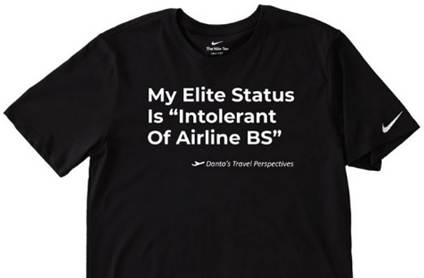 After decades of candid travel
commentary – from loyalty program “magic tricks” to hotel check-in roulette –
I’ve decided to turn some of that honesty into apparel. These aren’t novelty shirts; they’re the
exact truths every road warrior wishes they could say out loud. Whether you’re quietly muttering “My
loyalty points devalued while you read this shirt” or admitting “If
delays build character then I’m the whole movie’s
cast” you’ll find plenty of familiar sentiments… and more. Everything is
produced by a reputable outfit, with black tees that work under a sport jacket
plus hoodies and wicking travel gear for life on the road. The site also has my
honest and snarky takes on technology trade shows. Take a look at Tinyurl.com/TechAndTravelWear. Even if you’re not buying
they’re fun to read and commiserate – and if you do buy something, maybe I’ll
break even. If you want a style you
don’t see, just email me and I’ll add it.
After decades of candid travel
commentary – from loyalty program “magic tricks” to hotel check-in roulette –
I’ve decided to turn some of that honesty into apparel. These aren’t novelty shirts; they’re the
exact truths every road warrior wishes they could say out loud. Whether you’re quietly muttering “My
loyalty points devalued while you read this shirt” or admitting “If
delays build character then I’m the whole movie’s
cast” you’ll find plenty of familiar sentiments… and more. Everything is
produced by a reputable outfit, with black tees that work under a sport jacket
plus hoodies and wicking travel gear for life on the road. The site also has my
honest and snarky takes on technology trade shows. Take a look at Tinyurl.com/TechAndTravelWear. Even if you’re not buying
they’re fun to read and commiserate – and if you do buy something, maybe I’ll
break even. If you want a style you
don’t see, just email me and I’ll add it.
This article was written by David Danto and contains solely his own, personal
opinions.
All image and links provided above as reference under
prevailing fair use statutes.
Copyright 2026 David Danto
++++++++
As always, feel free to write and comment, question or
disagree. Hearing from the traveling
community is always a highlight for me.
Thanks!