



David J. Danto
Travel thoughts in my
own, personal opinion
eMail: ddanto@IMCCA.org Follow Industry News: @NJDavidD on 

The Little Things:
Danto’s Little Flight Tips May 2026
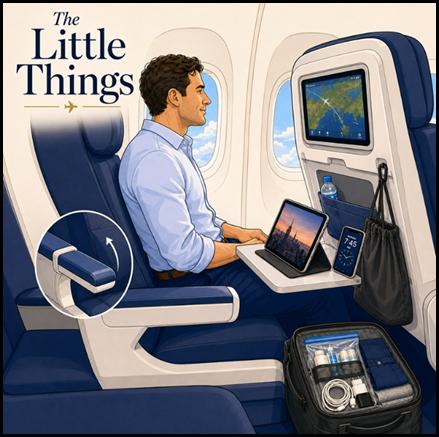 There are plenty of travel articles
about the big things. How
to pick a credit card. How to get elite
status. How to survive an international
connection. How to find the best fare. How to pack for two weeks in a carry-on bag,
which I admire in theory but have no interest in trying at this point in my
life.
There are plenty of travel articles
about the big things. How
to pick a credit card. How to get elite
status. How to survive an international
connection. How to find the best fare. How to pack for two weeks in a carry-on bag,
which I admire in theory but have no interest in trying at this point in my
life.
This is not one of those articles.
This one is about the little things –
my tiny habits, odd tricks, and personal systems that make my ordinary flights
a little easier. None of these will
change the course of aviation history. No
airline will create a new loyalty tier because I found a better way to store
stuff at my seat. But these are the habits
I’ve learned over time because, after enough flights, you start to notice where
things can break down or get easier.
I’ve decided to share these little
things this week because airline travel is often not made miserable by one big
thing. It’s often made miserable by a
hundred small ones. So here are a few of
my little travel things. Many may be
obvious, unglamorous or even nerdy – but they work, and you may not know them
all.
1.
Even if you check a bag, carry enough to survive without it
At my age, with all the things I need
to carry with me, I usually check a bag unless I am only going away for a day
or two. I know there are people who
consider checking luggage a personal failure.
Good for them – I used to be one of them. I have nothing but admiration for anyone who
can still travel for a week with a backpack, three shirts, and a religious
devotion to hotel laundry or the closest Walmart.
That is not me anymore.
But checking a bag does not mean
surrendering all control. Even when I
check luggage, I still bring a carry-on rollaboard onto the plane. In that rollaboard are my medications,
important supplies, valuables, and at least two days’ worth of clothing.
That is the key. If the checked bag does not make it where I
am going, I am not stranded with nothing but the clothes I wore on the plane,
waiting for whenever the airline decides to deliver my bag. I’ve learned that the baggage team’s “as soon
as possible,” is airline-speak for “we hope you enjoy this character-building
exercise.” They and their contractors have one speed, and it makes a growing Ficus
look speedy.
A delayed bag is annoying. A delayed bag with your medicine, chargers,
essential supplies, and every clean shirt you own is a problem. The goal is not to carry everything. The goal is to carry enough of the right
things so that if your checked bag takes a side trip to Cincinnati, you can
still function for a day or two while you either wait for delivery or go
shopping.
The practical rule is simple: if you
truly cannot do without it for 48 hours, it does not belong in the checked bag.
2.
Book the aisle if you need space or freedom
Coach seats are not getting roomier. I know this will not shock anyone who has
recently been on an airplane, but the modern airline seat is not designed
around human delight. It is designed
around the number of potatoes the airline bean counters can jam into the sack.
That is why I usually prefer an aisle
seat. The obvious reason is access. If you like to get up, use the restroom, walk
around, or reach your bag in the overhead bin, the aisle is your friend. You are not trapped. You are not negotiating with two sleeping
strangers. You are not practicing yoga
over someone’s knees.
But there is another advantage that
many people do not know about. On many
aircraft, and certainly on many United aircraft I have flown, the aisle-side
armrest can lift up. There is often a
small release button underneath and toward the back of the armrest. Push it, and the armrest comes up.
That can give you a couple of extra
inches of usable seat width, or at least remove the feeling that the armrest is
constantly pressing into your side. It
is not magic. It does not transform
coach into a suite. But on a long
flight, a little extra shoulder and hip room can make a real difference.
There is a courtesy issue here, of
course. You do not want to spill into
the aisle when flight attendants are working the cabin or carts are coming
through. The aisle is not your personal
annex. But when service is not happening
and you are just trying to sit more comfortably, lifting that armrest can make
the seat feel a little less hostile. Sometimes
the FAs ask you to put it down for take-off and landing, sometimes they don’t,
but it can stay up for the majority of the flight.
3.
Window seats can sometimes offer hidden room too
The aisle trick is more common, but
window seats sometimes have a version of this as well. Depending on the aircraft, there may be an
armrest between the window seat and the side wall of the plane. On some aircraft, that armrest may lift too,
creating a little extra space between you and the wall.
It is less predictable than the aisle
armrest. You cannot count on it as often. But it is worth checking.
The window seat has its own logic. If your plan is to sit down, stay put, look
out the window, work, sleep, or generally not interact with humanity until
landing, the window can be a great choice.
No one is climbing over you. No
cart is bumping your elbow. No person
walking down the aisle is using your shoulder as a handrail.
But if you know you are someone who
gets up often, the window seat is not your best friend. The little extra space, if available, may not
be worth the social choreography of asking two people to move every time you
want to stand up.
That is one of the overlooked parts
of seat selection. It is not just about
which seat is objectively “best.” It is about what kind of traveler you are on
that flight.
4.
Seatback pockets are not what they used to be
Seatback pockets used to be useful. Now, on many modern aircraft, they are barely
large enough to hold the safety card, an airsickness bag, and the vague memory
of when passengers had space.
The problem is that there are things
you want within reach during a flight. Glasses. A snack.
A cable. Earbuds. Napkins.
Medication. A pen. Something to wipe your hands. Maybe a small pouch of essentials. But you do not want all of that in your pants
pockets, and you may not want it under the seat either, especially if you have
long legs or large feet.
The space under the seat in front of
you is technically “storage.” It is also your footwell. Once you fill it with too much stuff, you
have created your own personal economy-class bear trap.
I use two solutions.
The first is a pouch device that slides into
the seatback pocket and hangs down, giving you a small zippered pouch for the
things that are too big for your pockets but not big enough to justify the
overhead bin. It is a simple idea, and
it works.
The second is even simpler. I keep one of those collapsible nylon tote
bags in my carry-on. It is the kind that
scrunches down small enough to fit in your fist but opens into a usable
lightweight bag. When I bring a bottle
of water onto the plane, I put the bottle in the seatback pocket and hang the
nylon bag over the bottle.
The bag generally hangs down and
swings under the seat in front of me. That
keeps it out of the way, keeps flight attendants from getting annoyed, and
keeps the things I want handy without forcing me to sacrifice all of my foot
space.
It is perfect for glasses, snacks,
food, small supplies, and the other things that otherwise end up scattered
around your seat area like you are nesting.
There is one extra courtesy step. If I get up to use the lavatory, I take the
bag off the water bottle and place it gently on my seat. That way it is not blocking anyone else in my
row who may need to get out while I am gone.
The trick is useful only if it does not become someone else’s problem.
5.
Do not assume the airplane bathroom water is your friend
Over the years, I have learned not to
trust the water that comes out of the tap in an airplane lavatory.
Maybe that sounds overly cautious. Maybe it is.
But I do not know how often those tanks and lines are cleaned, and the
older the aircraft, the less interested I am in finding out. I am sure there are rules, procedures,
maintenance schedules, and people who can explain why everything is fine. I am also sure I have seen enough airplane
bathrooms to make my own decision.
So I keep a small bottle of Purell in
my shirt pocket. If I use the restroom,
need to clean my hands, wipe my face, or deal with something messy, I would
rather use sanitizer or pour a little water from a bottle I bought at the
airport than rely on the aircraft lavatory tap.
This is not about managing
germophobia. It is about avoiding
unnecessary risk. Air travel already
gives you enough chances to pick up whatever the person in 22C brought onboard. I do not need to add mystery tank water to
the list.
6.
Cocktail napkins are underrated travel tools
I have developed a great appreciation
for cocktail napkins, especially the kind you get on airplanes, in airport
lounges, and at hotels. They are the
perfect size to fold and keep in a shirt pocket.
Yes, this may make me look like I am
one pen away from wearing a pocket protector.
I accept that.
But those little napkins are
incredibly useful. They are good for
small spills, wiping your hands after eating, cleaning up crumbs, blotting
something from a tray table, or dealing with whatever small mess travel throws
at you. A full-size napkin is often too
much. A tissue may fall apart. A paper towel is not always available. A cocktail napkin is just right.
Whenever I have access to them, I
tend to grab a few and keep them handy. It
is one of those small habits that seems silly until you need one. Then it feels like genius.
Small, low-tech, slightly nerdy
genius.
7.
Change your devices to the destination time as soon as the cabin door
closes
When I am flying to a different time
zone, I usually reset my mobile phone and watch manually to the arrival time
zone as soon as the cabin door closes.
Not when we land. Not halfway through the flight. Certainly not leaving it on automatic. Right away.
The reason is simple: I want my brain
to have the entire flight to start living in the destination time zone. If I keep looking at my watch and phone and
seeing the time where I started, my brain stays behind. If I switch immediately, I begin adjusting
mentally before the plane ever leaves the ground.
This is especially useful on longer
flights. You can start thinking about
whether you should sleep, eat, work, or stay awake based on where you are
going, not where you have been. It does
not eliminate jet lag, but it helps me acclimate.
It also helps to have a watch that
can show dual or multiple time zones. Mine
does, and I use that feature often. But
even if your watch does not, manually changing your phone and watch at the
start of the flight gives you a mental head start.
The moment the door closes, I am
already trying to live on arrival time.
8.
Bring your own entertainment, but use the IFE map
When I am flying on an aircraft with
in-flight entertainment (IFE), I check early to see whether there is anything I
actually want to watch. Sometimes there
is a new-release movie I have not seen. Usually
there is not.
I have learned to prepare for that.
I bring my iPad with me so I can
either work or watch content I already have, including movies carried on an
iPad-compatible flash drive. That way I
am not dependent on the airline’s entertainment library or whatever licensing
deal happened to be available that month.
But I still like the seatback screen
when it exists. I just use it
differently.
My preferred setup is to put the iPad
on the tray table for my own work or content and leave the IFE screen on the airline’s
moving map. That gives me the best of
both worlds. I am watching or doing what
I want, while the seatback display quietly tells me where we are and how much
flight time remains.
It becomes a very comfortable
combination because, at a glance, I always know where I am and how much longer
the flight has. I do not have to
interrupt what I am watching. I do not
have to open the airline app. I do not
have to wonder whether we are over Ohio, Kansas, or the part of the country
where time loses all meaning.
The map is the best channel on the
plane.
9.
A battery case is a gadget tip, but it belongs here too
This one probably belongs in one of
my Traveler’s Toolbox columns. (I’m actually
due to put another one of those together soon because I have a few gadgets I
want to share.)
But I am including it here anyway
because it is too important to leave out.
I use a mobile phone case with a
built-in battery. It makes the phone
heavier, and I understand why some people do not like that. It does not bother me. More importantly, it does two very useful
things.
First, it dramatically extends the
life of the phone without requiring me to attach to a separate charger. Second, it gives the phone extra protection
from drops and everyday abuse. Those are
both valuable when traveling.
I still bring a USB cable. If I am on a domestic aircraft with a
seatback USB port, I will usually plug the phone in through the battery case. I generally do not bother much with the AC
outlets on domestic flights unless I need them, though I pay more attention to
power options internationally. But if
there is USB power available, I use it.
That means that after a five- or
six-hour flight, my phone can land fully charged. That matters.
When you land, your phone suddenly becomes your boarding pass archive,
hotel confirmation, car service connection, map, wallet, email device,
messaging system, and emergency problem solver.
Landing with a dying phone is a
rookie mistake. Landing with a full one
is a small victory.
The little things add up
None of these tips is dramatic. Nobody is going to build an advertising
campaign around “bring cocktail napkins and distrust lavatory tap water.” At
least I hope not.
But that is the point. Business travel is full of little frictions. Most are not big enough to complain about
individually, but together they wear you down.
The more of them you can smooth out, the easier the day becomes.
A little more room in the seat and the other tips are not
grand travel hacks. They are just habits. But after enough years and enough flights,
you learn that comfort often comes from the little things no one bothers to
mention.
If you have tricks or habits I didn’t mention, please email
me and let me know. I’ll share any worthy
additions in a future article.

 After decades of candid travel
commentary – from loyalty program “magic tricks” to hotel check-in roulette –
I’ve decided to turn some of that honesty into apparel. These aren’t novelty shirts; they’re the
exact truths every road warrior wishes they could say out loud. Whether you’re quietly muttering “My
loyalty points devalued while you read this shirt” or admitting “If
delays build character then I’m the whole movie’s cast” you’ll find plenty
of familiar sentiments… and more. Everything is produced by a reputable outfit,
with black tees that work under a sport jacket plus hoodies and wicking travel
gear for life on the road. The site also has my honest and snarky takes on
technology trade shows. Take a look at Tinyurl.com/TechAndTravelWear. Even if you’re not buying they’re fun to read
and commiserate – and if you do buy something, maybe I’ll break even. If you want a style you don’t see, just email
me and I’ll add it.
After decades of candid travel
commentary – from loyalty program “magic tricks” to hotel check-in roulette –
I’ve decided to turn some of that honesty into apparel. These aren’t novelty shirts; they’re the
exact truths every road warrior wishes they could say out loud. Whether you’re quietly muttering “My
loyalty points devalued while you read this shirt” or admitting “If
delays build character then I’m the whole movie’s cast” you’ll find plenty
of familiar sentiments… and more. Everything is produced by a reputable outfit,
with black tees that work under a sport jacket plus hoodies and wicking travel
gear for life on the road. The site also has my honest and snarky takes on
technology trade shows. Take a look at Tinyurl.com/TechAndTravelWear. Even if you’re not buying they’re fun to read
and commiserate – and if you do buy something, maybe I’ll break even. If you want a style you don’t see, just email
me and I’ll add it.
This article was written by David Danto and contains solely his own, personal
opinions.
All image and links provided above as reference under
prevailing fair use statutes.
Copyright 2026 David Danto
++++++++
As always, feel free to write and comment, question or
disagree. Hearing from the traveling
community is always a highlight for me.
Thanks!