



David J. Danto
Travel thoughts in my
own, personal opinion
eMail: ddanto@IMCCA.org Follow Industry News: @NJDavidD on 

Kirby’s Dream, Our
Nightmare April 2026
 The other day, news broke that United Airlines CEO
Scott Kirby had floated the idea of merging United with American Airlines. On paper, I suppose that is the kind of thing
that makes bankers sit up straighter, consultants start sharpening pencils, and
Wall Street begin hallucinating about “synergies.” Out in the real world,
however, it should make the average airline passenger want to grab the nearest
airsickness bag.
The other day, news broke that United Airlines CEO
Scott Kirby had floated the idea of merging United with American Airlines. On paper, I suppose that is the kind of thing
that makes bankers sit up straighter, consultants start sharpening pencils, and
Wall Street begin hallucinating about “synergies.” Out in the real world,
however, it should make the average airline passenger want to grab the nearest
airsickness bag.
Because if your answer to the current state of U.S. air travel is, “Let’s have even less
competition,” then you are not trying to fix the problem. You are trying to formalize it.
Anyone who flies with any regularity already knows the
score. Service is down. Fees are up.
Legroom is treated like a luxury product. Schedules are padded. Routes are trimmed. Customer loyalty programs have been
transformed from rewards for frequent flyers into giant financial engineering
machines that seem to exist mainly to sell points to banks. Increasingly, the airlines feel less like
transportation companies and more like credit card marketing platforms with
wings attached as an optional accessory.
And now we are supposed to entertain the idea that combining
two of the largest carriers in the country would somehow improve things.
Please.
The United States airline industry already behaves like an
oligopoly in much of the country. At far
too many airports, the notion of meaningful nonstop competition is a joke. You can often fly nonstop on one dominant
carrier, maybe two if you are lucky, and everybody else sends you through a
connection somewhere inconvenient if it’s even possible. In those environments, pricing becomes a game
of “because we can.” Consumers do not have real choice. They have variations on captivity.
So when someone says the answer is to create an even bigger
airline, my response is simple: if that is the direction we are going, then let
us at least be honest about it.
Do not pretend this is still a healthy private market.
Do not tell me this is robust competition.
Do not give me a speech about consumer benefits while
simultaneously reducing the number of real alternatives available to consumers.
If United and American genuinely want to become one giant
national champion, then maybe we should stop halfway measures and go all the
way. Sell the whole thing – Delta and
the rest included – to the U.S. government.
Eliminate the fiction that this is some kind of vibrant free-market
ecosystem. Fold it into a public utility
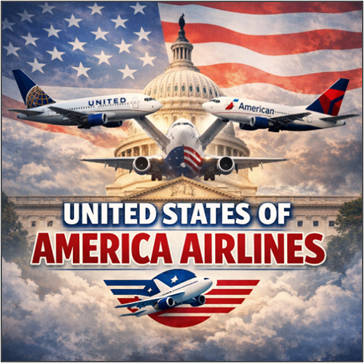
model. Call it United States of America
Airlines and be done with it.
Ridiculous? Yes. But not quite as ridiculous as continuing to
tell the public that serial consolidation is somehow pro-consumer.
At least a government-owned airline would be honest about
what it is.
And before the usual crowd starts shouting that government
ownership always produces disaster, let us calm down and look around the
world. There are state-backed or
state-linked airlines that are run quite well, and there are state-backed or
state-linked airlines that are run poorly.
In other words, they look suspiciously like privately owned
airlines. Competence still matters. Management still matters. Route strategy still matters. Customer experience still matters. Ownership structure alone does not magically
create excellence, but neither does private ownership. American aviation has spent years proving
that point with great enthusiasm.
That is the part I find most revealing here. We are constantly told that the private
sector is the gold standard because competition disciplines bad behavior. Fine.
Then where exactly is the discipline now? Where is the competition?
Where is it when service keeps getting worse?
Where is it when the passenger experience becomes a
laboratory experiment in how much discomfort people will tolerate before giving
up?
Where is it when airlines can make more strategic fuss over
co-branded credit cards and loyalty monetization than over whether the basic
act of flying is pleasant, reliable, and humane?
The dirty little secret of the modern airline industry is
that flying people around is most definitely the side hustle. The glamour business is miles, points,
partnerships, and financial extraction.
The plane is still there, of course, because it has to be. But too often it feels like the flying exists
to feed the loyalty machine, not the other way around.
That is one reason the merger idea lands so badly. Passengers are already frustrated. They already suspect that the system is
designed around shareholder priorities first, executive ambition second, and
customer welfare somewhere down near the bottom, probably in the overhead bin
where there is no room left. Floating a
United-American merger at this moment is basically telling the public, “You
think this is shitty now? Hold my
boarding pass.”
And let us be clear about one more thing: this would not be a
merger designed to rescue some broad public good. It would be a merger designed to create
scale, bargaining power, and market leverage.
Those are wonderful things to have if you are the airline. They are usually lousy things to face if you
are the traveler.
The defenders will say a larger airline could compete better
against foreign carriers. Maybe. They will say it could create a stronger
global network. Also maybe. They will say there would be
efficiencies. There are always
“efficiencies.” That word tends to mean fewer overlapping operations, fewer
flights in some markets, fewer employees, and fewer choices for customers, all
wrapped in a PowerPoint presentation with a majestic blue gradient that gets
Wall Street excited.
What it rarely means is a suddenly more delightful trip for
the person in seat 29B.
So here is my counterproposal. If the airline industry wants to keep
consolidating until it effectively resembles a national transport cartel, then
stop pretending that private ownership is preserving some sacred consumer
paradise. Either preserve real
competition, or admit that the game is over and regulate the resulting giant
like the essential infrastructure it increasingly resembles.
Personally, I would rather see a market with more
competition, more point-to-point options, and more pressure on carriers to win
passengers through service rather than trap them through geography and loyalty
schemes. But if the industry insists on
building one giant flag carrier by attrition and merger, then I am at least
open to the radical honesty option: make it public, make it accountable, and
strip the greed premium out of the equation.
Would that be better?
Maybe. Worse? Also maybe.
But at least it would stop insulting our intelligence.
Because the worst possible outcome is the one we keep
drifting toward now: a supposedly private system with public bailouts for every
crisis, shrinking competition in normal times, mounting customer misery, and
executives still insisting that the answer is even less choice than we already
have.
That is not a free market.
That is a rigged boarding process.
Oh yes, and one more thing.
If we do nationalize the U.S. airline industry, none of the current
executives should be allowed to stay involved.
Let them cash out and retire somewhere – preferably as far away from
passengers as possible – and let the profit motive once and for all be removed
from the system.
Maybe service will improve, maybe it will degrade, but at
least neither will happen because some C-suite puffed shirt thought his
quarterly bonus would be higher by doing it.
(By the way, Kirby’s United – American rumor got so loud that
American Airlines had to issue a statement that they had nothing to do with it…and
are not interested.)

 After decades of candid travel
commentary – from loyalty program “magic tricks” to hotel check-in roulette –
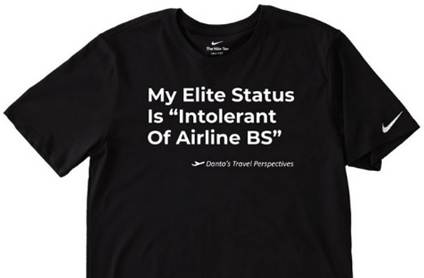
I’ve decided to turn some of that honesty into apparel. These aren’t novelty shirts; they’re the
exact truths every road warrior wishes they could say out loud. Whether you’re quietly muttering “My
loyalty points devalued while you read this shirt” or admitting “If
delays build character then I’m the whole movie’s cast” you’ll find plenty
of familiar sentiments… and more. Everything is produced by a reputable outfit,
with black tees that work under a sport jacket plus hoodies and wicking travel
gear for life on the road. The site also has my honest and snarky takes on
technology trade shows. Take a look at Tinyurl.com/TechAndTravelWear. Even if you’re not buying they’re fun to read
and commiserate – and if you do buy something, maybe I’ll break even. If you want a style you don’t see, just email
me and I’ll add it.
After decades of candid travel
commentary – from loyalty program “magic tricks” to hotel check-in roulette –
I’ve decided to turn some of that honesty into apparel. These aren’t novelty shirts; they’re the
exact truths every road warrior wishes they could say out loud. Whether you’re quietly muttering “My
loyalty points devalued while you read this shirt” or admitting “If
delays build character then I’m the whole movie’s cast” you’ll find plenty
of familiar sentiments… and more. Everything is produced by a reputable outfit,
with black tees that work under a sport jacket plus hoodies and wicking travel
gear for life on the road. The site also has my honest and snarky takes on
technology trade shows. Take a look at Tinyurl.com/TechAndTravelWear. Even if you’re not buying they’re fun to read
and commiserate – and if you do buy something, maybe I’ll break even. If you want a style you don’t see, just email
me and I’ll add it.
This article was written by David Danto and contains solely his own, personal
opinions.
All image and links provided above as reference under
prevailing fair use statutes.
Copyright 2026 David Danto
++++++++
As always, feel free to write and comment, question or
disagree. Hearing from the traveling
community is always a highlight for me.
Thanks!