



David J. Danto
Travel thoughts in my
own, personal opinion
eMail: ddanto@IMCCA.org Follow Industry News: @NJDavidD on 

United Turns Hunger into Homework – January 2026
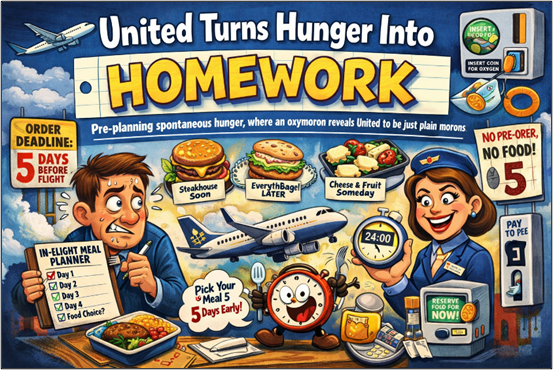
Pre-planning
spontaneous hunger – an oxymoron that makes United look like just plain morons.
 Picture this: You
wake up with a fever and a sore throat, so you head to the doctor. You fill out the forms, you sit down in the
waiting room, and finally the nurse calls your name. The doctor walks in, glances at the chart,
and says with perfect sincerity: “I’m afraid I can’t treat you. You didn’t pre-order your illness three days
ago. If you’d let us know your diagnosis
by last Thursday, we’d be delighted to help.”
Picture this: You
wake up with a fever and a sore throat, so you head to the doctor. You fill out the forms, you sit down in the
waiting room, and finally the nurse calls your name. The doctor walks in, glances at the chart,
and says with perfect sincerity: “I’m afraid I can’t treat you. You didn’t pre-order your illness three days
ago. If you’d let us know your diagnosis
by last Thursday, we’d be delighted to help.”
Absurd, right?
No reasonable person would tolerate that kind of transactional
scheduling for things that arise from basic human needs. Now imagine walking into a restaurant because
you’re hungry. The host smiles and asks
if you pre-ordered your steak. No? Then no dice.
Not only did you fail to reserve, you failed to select the specific
entrée five days in advance. Try the
gift shop on your way out and good luck.
Welcome to United Airlines’ brave new bistro economy,
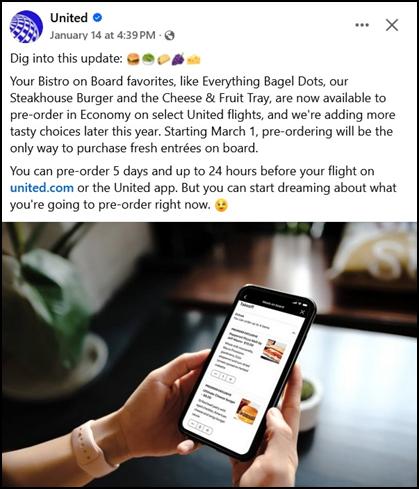
where common sense has apparently been misplaced somewhere over Chicago. Without any significant communication to
passengers or even a modest pulse of fanfare, the airline quietly dropped a
nugget on its Facebook page announcing that Bistro on Board – the branded term
for the fresh items they sell in economy – will soon be available only through
pre-order. As of March 1, the only way
to get a “fresh entrée” on a domestic flight is to know exactly what you’ll
want to eat between five days and twenty-four hours before departure, log into
United.com or the app, and place your culinary futures bet.
Who on earth knows what they’re going to be hungry for
five days before a flight? Even
twenty-four hours feels like an optimism test.
Maybe you’re on a business trip.
Maybe you don’t know when you’re going to have your next proper
meal. Maybe you don’t know if you’ll
still be in the mood for an Everything Bagel at 35,000 feet when your stomach
is processing the airport smoothie you inhaled at the gate. Normal life involves spontaneity – especially
around the very primal drive to eat.
The logic, of course, isn’t culinary. It’s bean counting. If passengers must pre-order, United never
has to stock extras. No leftovers, no
spoilage, and above all no risk that passengers might actually get hungry and
decide to purchase something onboard at the time humans typically decide to
purchase food, which is… when they’re hungry.
This is the same mentality that inspires the sky-god temptation to meter
bathroom access and sell oxygen by the inhale.
We’ve seen airlines squeeze before. Checked bags became paid. Seat selection became paid. Legroom evaporated into micro-economies of
knees and elbows. But shrinking the
spontaneity of eating – a function most mammals handle without scheduling apps
– represents a new frontier where “fresh food” is less a service and more a
logistics experiment.
 And consider the communication strategy. This isn’t a splashy announcement with
consumer-facing rationale about reducing waste or improving choice. It’s not even the typical operational
downgrade positioned with airline-speak as a premium offering. Instead, it quietly materializes on social
media like a note slipped under the door at 2 a.m., informing passengers that
the rules of biology have changed and that hunger must now be forecast like
weather.
And consider the communication strategy. This isn’t a splashy announcement with
consumer-facing rationale about reducing waste or improving choice. It’s not even the typical operational
downgrade positioned with airline-speak as a premium offering. Instead, it quietly materializes on social
media like a note slipped under the door at 2 a.m., informing passengers that
the rules of biology have changed and that hunger must now be forecast like
weather.
The airline business always wrestles with inventory
and cost, and fresh food is genuinely hard to manage. But good hospitality anticipates needs rather
than outsourcing them to spreadsheets and asking customers to predict their
caloric futures. Travelers already plan
enough: hotels, rental cars, meetings, boarding times, security lines, loyalty
bait and switch schemes, upgrades, seat maps, and whether the person next to
them will respect armrest boundaries.
The idea that they should also pre-schedule their sandwich window feels
like a test of how far the industry can push rational passengers before they
revolt.
And here’s the kicker: passengers who can bring their
own food already do. The entire
justification for onboard food sales – the replacement for meals that used to
be free – is to serve the people who couldn’t work out any other option. Those are exactly the people least able to
know, days in advance, what they’ll want or even whether they’ll have time to
plan.
There’s also an unsaid class element here. Polaris customers and those up front won’t be
asked to pre-order their meals out of existential necessity; the premium cabin
still operates on the old assumption that part of what you paid for is being
fed. Economy, meanwhile, becomes an
experiment in gated access to nourishment – a pay-to-participate model with a
120-hour reservation period.
Maybe this really is where travel is headed. Maybe airlines will soon encourage passengers
to pre-order hydration, restroom usage slots, and overhead bin access. Maybe eating will become a subscription
tier. (My apologies to the accountant
that just swooned and wet their underwear over that idea.) Or, maybe, someone at United will eventually
realize that food is not a luxury product, it is a human function, and that
spontaneity is not an operational defect.
For now, though, passengers should be advised: if
you’re flying United and you expect to eat something that didn’t come from your
backpack or the airport concession (another experiment in greed unto itself),
start planning days in advance. And
while you’re at it, try to predict which version of yourself you’ll be when the
cabin lights dim – the fruit and cheese person, the steakhouse burger person,
or the deeply regretful person wondering why they didn’t just grab an
over-spiced, overpriced, stale sandwich in the terminal.
[Correction – an earlier version of this blog stated there
was no press release by United, and that was incorrect. Regardless of the release, most passengers
were and are not aware of this ridiculous change.]

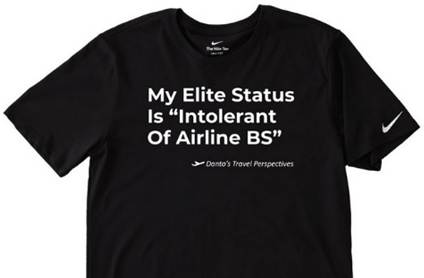 After decades of candid travel
commentary – from loyalty program “magic tricks” to hotel check-in roulette –
I’ve decided to turn some of that honesty into apparel. These aren’t novelty shirts; they’re the
exact truths every road warrior wishes they could say out loud. Whether you’re quietly muttering “My
loyalty points devalued while you read this shirt” or admitting “If
delays build character then I’m the whole movie’s cast” you’ll find plenty
of familiar sentiments… and more. Everything is produced by a reputable outfit,
with black tees that work under a sport jacket plus hoodies and wicking travel
gear for life on the road. The site also has my honest and snarky takes on
technology trade shows. Take a look at Tinyurl.com/TechAndTravelWear. Even if you’re not buying they’re fun to read
and commiserate – and if you do buy something, maybe I’ll break even. If you want a style you don’t see, just email
me and I’ll add it.
After decades of candid travel
commentary – from loyalty program “magic tricks” to hotel check-in roulette –
I’ve decided to turn some of that honesty into apparel. These aren’t novelty shirts; they’re the
exact truths every road warrior wishes they could say out loud. Whether you’re quietly muttering “My
loyalty points devalued while you read this shirt” or admitting “If
delays build character then I’m the whole movie’s cast” you’ll find plenty
of familiar sentiments… and more. Everything is produced by a reputable outfit,
with black tees that work under a sport jacket plus hoodies and wicking travel
gear for life on the road. The site also has my honest and snarky takes on
technology trade shows. Take a look at Tinyurl.com/TechAndTravelWear. Even if you’re not buying they’re fun to read
and commiserate – and if you do buy something, maybe I’ll break even. If you want a style you don’t see, just email
me and I’ll add it.
This article was written by David Danto and contains solely his own, personal
opinions.
All image and links provided above as reference under
prevailing fair use statutes.
Copyright 2026 David Danto
++++++++
As always, feel free to write and comment, question or
disagree. Hearing from the traveling
community is always a highlight for me.
Thanks!