

David J. Danto
Travel thoughts in my
own, personal opinion
eMail: ddanto@IMCCA.org Follow Industry News: @NJDavidD on 

Greed II October 2026
 A couple of
years ago, I wrote a column called “Greed” about the
Netflix documentary Downfall: The Case Against Boeing. It was a
horrifying and frightening look at how Boeing, a company once defined by
engineering excellence, allowed greed, cost-cutting and financial priorities to
contribute to two 737 MAX crashes that killed 346 people.
Well, there is now a sequel.
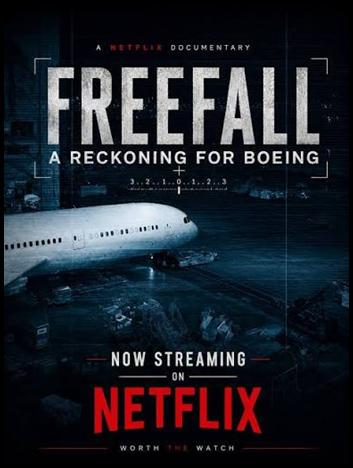
Freefall:
A Reckoning for Boeing is available on Netflix, from the same director, Rory Kennedy, and it
continues the story of what happened at Boeing after Downfall. Netflix
itself describes it as Kennedy’s follow-up to the earlier film.
It is an absolute must-watch documentary for every traveler.
I’m serious. Stop whatever you’re doing right now and watch it. This article
will be here for you when you’re done.
Amazingly, Freefall may be even more disturbing
than Downfall.
The first film explained how Boeing got to the point
where two airplanes could crash because a company that once allowed engineers
to lead had adopted a culture where cost, schedule, stock price and executive
compensation became dominant priorities. The new film asks the obvious
question: After 346 people died, investigations were held, executives testified
before Congress, the 737 MAX was grounded around the world and Boeing promised
to change, did it?
The answer presented by Freefall is terrifying.
Clearly, nothing has changed.
What makes the documentary so effective is that it
broadens the story beyond the MAX crashes. It focuses heavily on Boeing
whistleblowers, particularly John Barnett, the longtime quality manager who
warned about serious manufacturing and safety issues involving the 787
Dreamliner. It also takes us through the January 2024 Alaska Airlines incident
in which a door plug blew out of a 737 MAX 9 shortly after takeoff. Four bolts
that were supposed to hold the plug in place were missing.
Think about that for a moment. We are not talking
about some obscure line of computer code behaving in an unexpected way. We are
talking about bolts. On an airplane.
But one of the most important things Freefall
does is trace the philosophy behind all of this. It spends time examining the
influence of the Jack Welch school of management on Boeing’s leadership, and
that struck a nerve with me because I have never believed in that philosophy.
Welch became legendary at General Electric for
relentlessly pursuing efficiency, shareholder return and financial performance.
His management philosophy also became associated with “stack ranking” employees
and regularly eliminating those at the bottom. The concept was that there
should always be a bottom group of performers who knew their jobs were at risk.
I have always found that idea horrific and inhuman.
I would never want to work on a team where everyone
wasn’t expected to be a star. If someone genuinely cannot perform a job, that
is obviously a management issue that needs to be addressed. But deliberately
creating a system in which there must always be losers – regardless of how good
the overall team might be – doesn’t create excellence. It creates fear. It
encourages people to protect themselves rather than one another. It encourages
them to tell management what management wants to hear. And, most dangerously,
it discourages the person who sees something wrong from raising his or her hand
and saying, “Stop.”
That might be a lousy way to run almost any company.
It has proven to be a deadly way to build airplanes.
Freefall
shows what happens when that philosophy is combined with the relentless
extraction of value from a company. Senator Josh Hawley (a person with whom I
often don’t agree in any way) confronts former Boeing CEO Dave Calhoun in
footage from a Senate hearing, attacking a system that still rewarded
executives handsomely while Boeing deteriorated because of their policies.
The larger point is difficult to miss: You can only
strip-mine a company for so long before you begin stripping away the things
that made the company valuable in the first place.
You can squeeze suppliers. You can outsource
manufacturing. You can reduce headcount. You can pressure employees. You can
move work to wherever somebody promises to do it cheaper. You can reward
executives for improving financial metrics. You can return enormous amounts of
money to shareholders.
On a spreadsheet, all of those things can look
terrific.
An airplane doesn’t fly on a spreadsheet. Husbands,
wives, children – human beings are neither safer nor given a better experience
while executives and shareholders laugh all the way to the bank. We frequent travelers
have more than enough proof of that. Excellence in performance and excellence
in stock performance are often not correlated at all.
Eventually you start pulling blood from a stone. And
when the company makes airplanes, the consequences of extracting that last
dollar can be measured in something other than quarterly earnings.
That is the part of this story that should concern
every traveler because we have watched a variation of it throughout the airline
industry for decades. In fact, that’s exactly what I was writing about in Greed.
Airlines remove a little more space, eliminate another employee, outsource
another function, cut another service and find another fee. Executives are
rewarded for extracting another few dollars from every passenger and another
few percentage points from every operation. Each individual decision can be
rationalized as efficiency.
There has to be a line between efficiency and
destruction.
At Boeing, Freefall makes a powerful case that
the line was crossed long ago.
The most infuriating part is how little genuine
accountability appears to have followed. Boeing entered into agreements with
the government, paid penalties, replaced executives and repeatedly promised
improvement. Yet the new documentary introduces more whistleblowers describing
a culture in which people responsible for quality say they were ignored,
pressured or punished for raising concerns. Boeing disputes some of the
allegations in the film and says it has addressed or continues to address
others.
But a few years after Downfall, Kennedy had
enough material to make another feature-length documentary.
That alone is astonishing.
In Greed, I wrote about a company that I
believed had gotten away with killing 346 people because engineering excellence
had been subordinated to financial priorities. I hoped the horror exposed by Downfall
represented the bottom – the point where Boeing, regulators, lawmakers and the
flying public would finally demand that the company rediscover what had once
made the Boeing name synonymous with aviation excellence.
Freefall
makes that optimism look naïve.
And that leaves travelers with an uncomfortable
problem. I fly constantly. For most of my life, seeing Boeing on an aircraft
was reassuring. Boeing represented American engineering at its best. Today I
find myself looking at the aircraft type when booking a flight and thinking
about things I never used to think about.
After watching Freefall, it is difficult not to
wonder whether I want to fly on another Boeing aircraft.
Then comes the even more disturbing thought.
If the management philosophy that allowed this to
happen is not unique to Boeing – if the same relentless pursuit of shareholder
value, executive compensation, outsourcing, cost reduction and doing more with
less has permeated the airlines, manufacturers, maintenance organizations and
other companies upon which modern aviation depends – perhaps the question isn’t
whether I want to fly on another Boeing.
It is how comfortable I should be flying on anything.
If you travel, watch Downfall if you
haven’t already. Then watch Freefall.
Just don’t expect to sleep particularly well
afterward.

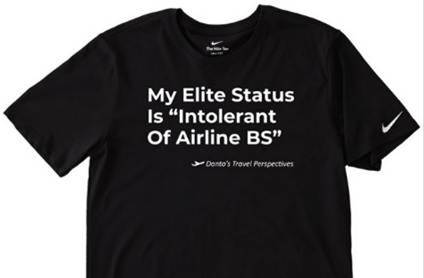
After decades
of candid travel commentary – from loyalty program “magic tricks” to hotel
check-in roulette – I’ve decided to turn some of that honesty into
apparel. These aren’t novelty shirts;
they’re the exact truths every road warrior wishes they could say out
loud. Whether you’re quietly muttering “My
loyalty points devalued while you read this shirt” or admitting “If
delays build character then I’m the whole movie’s cast” you’ll find plenty
of familiar sentiments… and more. Everything is produced by a reputable outfit,
with black tees that work under a sport jacket plus hoodies and wicking travel
gear for life on the road. The site also has my honest and snarky takes on
technology trade shows. Take a look at Tinyurl.com/TechAndTravelWear. Even if you’re not buying they’re fun to read
and commiserate – and if you do buy something, maybe I’ll break even. If you want a style you don’t see, just email
me and I’ll add it.
This article was written by David Danto and contains solely his own, personal
opinions.
All image and links provided above as reference under
prevailing fair use statutes.
Copyright 2026 David Danto
++++++++
As always, feel free to write and comment, question or
disagree. Hearing from the traveling
community is always a highlight for me.
Thanks!