



David J. Danto
Travel thoughts in my
own, personal opinion
eMail: ddanto@IMCCA.org Follow Industry News: @NJDavidD on 

Airline Costs Are Dropping,
But Not For Us July 2026
 I hate saying I told you so. Actually, that is not completely true. I enjoy it tremendously when I can accurately
predict the future. I just wish I were
wrong more often when the subject is business travel pricing.
I hate saying I told you so. Actually, that is not completely true. I enjoy it tremendously when I can accurately
predict the future. I just wish I were
wrong more often when the subject is business travel pricing.
When the conflict around the Strait of Hormuz first pushed
fuel prices higher, I wrote that airfares would go up quickly and then, in the
usual airline tradition, somehow forget how to come back down. The airlines would blame fuel, blame
uncertainty, blame geopolitics, blame capacity, blame anything with a pulse. Then, when the underlying cost pressure
eased, the pricing would remain right where it was.
That is basically where we are now.
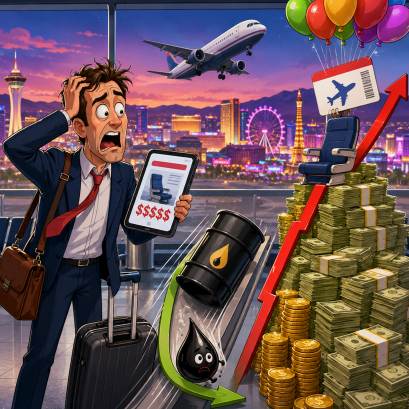
According to reporting citing Deutsche Bank, jet fuel prices
have fallen sharply from their wartime spike.
Fuel may be materially cheaper for the airlines, but the passenger
experience has not changed much at all. Fares
remain elevated, and the reasons are painfully familiar: carriers cut routes,
did not restore enough capacity, pushed through repeated fare hikes, and
benefited from the loss of Spirit Airlines as a meaningful low-cost pressure
point in many markets.
In other words, the emergency pricing became the new pricing.
This is one of the oldest tricks in travel economics. When costs go up, the increase is passed
through quickly and dramatically. When
costs go down, the savings become “margin recovery,” “capacity discipline,”
“network optimization,” or whatever other phrase sounds better on an
earnings call than “we are keeping the money.”
Business travelers already know this game. The airlines spent the last few years
teaching customers that less can cost more.
Fewer flights. Fewer nonstops. Fewer seats available at reasonable prices. Fewer low-cost competitors. More fees.
More complexity. More paid
upgrades. More branded fare bundles
designed to make the old basic product look like a premium experience.
The fuel spike simply gave the industry another reason to
raise prices. The fuel decline has not
given passengers a reason to see relief.
That should matter to corporate travel managers because this
is not just a vacation-season annoyance.
It is a budgeting issue. If
summer leisure demand holds, airlines have little incentive to give back
pricing power. If fall demand softens,
they may discount selectively, but that does not mean the broader fare
structure resets. Airlines have become
very good at controlling supply rather than chasing volume. They would rather operate fewer flights at
higher yields than flood the market and compete aggressively on price.
Case in point: I just priced out a December trip to Las Vegas
from Newark for another conference. The
lowest non-stop fare on United shows at a reasonable $407. But when one peels back that fare, it is for
Basic Economy, the stripped-down product that does not include normal seat
selection, changes, or much else. That
price moves to over $600 when a normal fare is selected, roughly double what
that trip should cost. And for that
extra cash, United stopped flying the 739s / 757s on that route, so no more
convenient mid-cabin lavatories to and from Las Vegas.
That is great for airline investors. It is lousy for anyone trying to manage a
travel budget.
The loss of Spirit makes this worse. Love it or hate it, Spirit kept pressure on
the market. Even travelers who never
flew Spirit benefited from its presence because its fares forced other airlines
to respond. Remove that pressure, and
the “competitive” fare from a legacy carrier starts to look a lot less
competitive. The market does not need
every traveler to choose the low-cost carrier.
It only needs the low-cost carrier to exist.
Now, on many routes, that pressure is weaker or gone.
So yes, jet fuel is down.
But the fare environment is not. That
tells us something important: this was never only about fuel. Fuel was the excuse, capacity was the
mechanism, and reduced competition was the gift.
For business travelers, the lesson is simple. Do not assume fares will normalize just
because the headline cost driver has eased.
Build budgets around the market we actually have, not the one we think
should exist. Book earlier where
possible. Watch nonstop premiums. Recheck fares after booking if your company
tools allow it. And be very careful
about assuming that a temporary shock will produce temporary pricing.
Airlines have learned that passengers will absorb a lot of
pain before changing behavior. They have
also learned that corporate travel often has to happen regardless of price. That gives them confidence to hold the line.
The phrase “fuel surcharge” always sounded temporary. The pricing behavior behind it rarely is.
So, unfortunately, this is the part where I get to say it: I
told you so. The airlines got their fare
hike. The fuel prices came down. The passengers are still paying.
Shocking, I know.

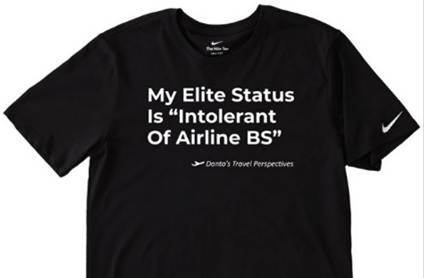
After
decades of candid travel commentary – from loyalty program “magic tricks” to
hotel check-in roulette – I’ve decided to turn some of that honesty into
apparel. These aren’t novelty shirts;
they’re the exact truths every road warrior wishes they could say out
loud. Whether you’re quietly muttering “My
loyalty points devalued while you read this shirt” or admitting “If
delays build character then I’m the whole movie’s cast” you’ll find plenty
of familiar sentiments… and more. Everything is produced by a reputable outfit,
with black tees that work under a sport jacket plus hoodies and wicking travel
gear for life on the road. The site also has my honest and snarky takes on
technology trade shows. Take a look at Tinyurl.com/TechAndTravelWear. Even if you’re not buying they’re fun to read
and commiserate – and if you do buy something, maybe I’ll break even. If you want a style you don’t see, just email
me and I’ll add it.
This article was written by David Danto and contains solely his own, personal
opinions.
All image and links provided above as reference under
prevailing fair use statutes.
Copyright 2026 David Danto
++++++++
As always, feel free to write and comment, question or
disagree. Hearing from the traveling
community is always a highlight for me.
Thanks!