



David J. Danto
Travel thoughts in my
own, personal opinion
eMail: ddanto@IMCCA.org Follow Industry News: @NJDavidD on 

They’ll Offer You An Itinerary You Can’t Refuse May 2026
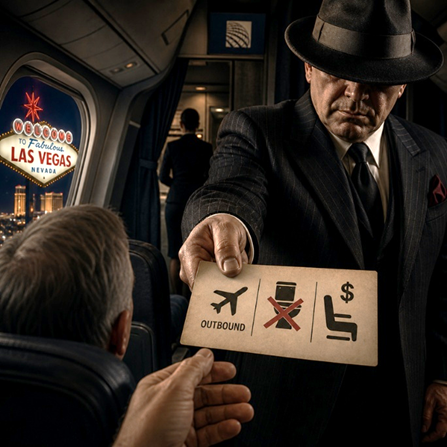 There was a time when flying felt like a choice. Not just a choice of destination, but a
choice of experience. You picked an
airline the way you picked a restaurant – because you liked how they treated
you, how they differentiated themselves, and how they made the journey part of
the trip.
There was a time when flying felt like a choice. Not just a choice of destination, but a
choice of experience. You picked an
airline the way you picked a restaurant – because you liked how they treated
you, how they differentiated themselves, and how they made the journey part of
the trip.
Somewhere along the line, that version of the airline
industry disappeared. Nowadays it seems
more like organized crime than customer service.
This week was a reminder of just how far things have drifted.
I’m heading out to Las Vegas in June for a conference (again.)
It’s a trip I booked months ago with the usual level of care and strategy that
comes from doing this for decades. Like
a lot of frequent travelers, I have my preferences. Mine aren’t particularly exotic – I look for
aircraft with mid-cabin lavatories. On a
five-hour flight, that’s not a luxury. That’s
practicality. It’s the difference
between a reasonably comfortable trip and one where I’m trekking from the front
to the back of the plane like it’s a fitness challenge I didn’t sign up for.
Then a text came in yesterday.
Not an email. Not a
polite heads-up. Just a quick
notification that United had “updated” my flights. Translation: they swapped out the aircraft,
moved my seats, and eliminated the one feature I specifically booked around. No conversation. No option presented up front. Just a done deal. It was the proverbial offer I couldn’t refuse,
with no intent on offering dialogue.
And here’s where the modern airline experience really seems
like the Don talking to you. If you
don’t like it, you still have options. Not
good ones mind you, but options, starting with deciding not to go. As that was not practical for this business
trip, I started exploring how to rebuild to a tolerable experience.
For the outbound flight, I was able to find one later non-stop
flight still using an aircraft that worked for me. It leaves about two and a half hours later,
which is inconvenient but manageable. The
catch? Even though United made the
aircraft change, moving to that flight still cost me another $50. Not a fortune, but enough to remind you who’s
in control of the relationship.
The return trip wasn’t as “lucky.”
There were no better aircraft options coming home. Every non-stop return flight LAS-EWR that day
was on a MAX 8, which meant no mid-cabin lavatory. So the only real
option if I want to be near the front of the plane is to try to get into first
class. I was willing to pay for an
upgrade, but they started at the ridiculous level of $999 and went up from
there to about $2,000.
That is a lot of money to solve what used to be a basic
comfort issue.
So, while I was still processing that, I woke up the next
morning to the news that Spirit had ceased operations, leaving travelers
stranded and scrambling. And just like
that, the emotional pendulum swings the other way. Suddenly, my annoyance with United starts to
feel like a first-world problem. At
least I’m still getting from Newark to Las Vegas and back. Many other travelers are now facing the far
worse “whataya gonna do
about it.”
And that’s the strange place the airline industry has landed.
They can make you feel frustrated, nickel-and-dimed, and
largely ignored – and then, in the very next moment, make you feel lucky that
your flight exists at all.
It’s a race to the least common denominator.
Airlines used to compete on quality. There was a time when the pitch (pun intended)
was about service, comfort, and experience.
You looked forward to flying. There
were meals that resembled actual food. There
was a sense that the airline wanted your business and was willing to earn it.
Today, the competition feels more like this: we’ll get you
there. Probably. And if we don’t, again, “whataya gonna do about it.”
There are, of course, reasons behind some of this. Fuel prices fluctuate. Global conflicts ripple through route
planning and capacity decisions. Most airlines
(definitely not Spirit) have become incredibly efficient at managing costs,
which, depending on your perspective, is either smart business or a masterclass
in how to remove every ounce of humanity from the experience.
But efficiency has a cost.
When every decision is optimized for margin, the passenger
experience becomes secondary. Aircraft
swaps happen because they make operational sense, not because they preserve the
experience someone thought they were buying.
Seat changes are just database updates.
Features that matter to travelers – like something as simple as where
the lavatory is located – don’t even register in the equation.
And over time, that adds up.
For those of us who have been flying for decades – and in my
case, creeping up on two million miles – the contrast is hard to ignore. This isn’t nostalgia for nostalgia’s sake. The industry genuinely used to feel different. Not perfect, not always glamorous, but
fundamentally more focused on the passenger as a customer rather than a unit of
revenue – or even worse, a target of airline to bank mileage sales.
There was a day when I might consider paying $1,000 for a five-hour
domestic flight upgrade, but that was when the service and experience warranted
it, not just to escape the inconvenience of flying on an aircraft I didn’t choose
in a seat I didn’t choose.
Now, the bar has moved.
If an airline gets you from point A to point B with minimal
disruption, that’s considered a win. If
they manage to do it without changing your seat, your aircraft, or your
departure time, that’s almost exceptional.
And if they don’t cancel outright, you’re supposed to feel grateful.
That’s a pretty sad place for an industry that once defined
travel.
I’ll take the later outbound flight. I’ll put in for a mileage upgrade on the
return and laughingly hope for the best (as those don’t ever clear anymore
either.) I’ll probably still get to Las Vegas on time and do what I need to do. From a purely functional standpoint, the
system is working.
But somewhere between the text message and the $50 change,
between the $999 upgrade and the news of another airline disappearing, it’s
hard not to feel like we’ve traded something meaningful for that functionality.
We used to fly on aircraft run by big corporations to get to
gangster run Las Vegas. Now we fly on
essentially gangster run airlines to get to corporate run Las Vegas.
It’s just another example that we definitely got bumped into
the wrong timeline somewhere along the way.

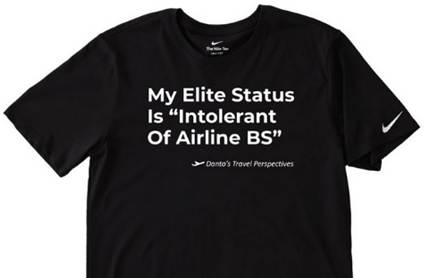 After decades of candid travel
commentary – from loyalty program “magic tricks” to hotel check-in roulette –
I’ve decided to turn some of that honesty into apparel. These aren’t novelty shirts; they’re the
exact truths every road warrior wishes they could say out loud. Whether you’re quietly muttering “My
loyalty points devalued while you read this shirt” or admitting “If
delays build character then I’m the whole movie’s
cast” you’ll find plenty of familiar sentiments… and more. Everything is
produced by a reputable outfit, with black tees that work under a sport jacket
plus hoodies and wicking travel gear for life on the road. The site also has my
honest and snarky takes on technology trade shows. Take a look at Tinyurl.com/TechAndTravelWear. Even if you’re not buying
they’re fun to read and commiserate – and if you do buy something, maybe I’ll
break even. If you want a style you
don’t see, just email me and I’ll add it.
After decades of candid travel
commentary – from loyalty program “magic tricks” to hotel check-in roulette –
I’ve decided to turn some of that honesty into apparel. These aren’t novelty shirts; they’re the
exact truths every road warrior wishes they could say out loud. Whether you’re quietly muttering “My
loyalty points devalued while you read this shirt” or admitting “If
delays build character then I’m the whole movie’s
cast” you’ll find plenty of familiar sentiments… and more. Everything is
produced by a reputable outfit, with black tees that work under a sport jacket
plus hoodies and wicking travel gear for life on the road. The site also has my
honest and snarky takes on technology trade shows. Take a look at Tinyurl.com/TechAndTravelWear. Even if you’re not buying
they’re fun to read and commiserate – and if you do buy something, maybe I’ll
break even. If you want a style you
don’t see, just email me and I’ll add it.
This article was written by David Danto and contains solely his own, personal
opinions.
All image and links provided above as reference under
prevailing fair use statutes.
Copyright 2026 David Danto
++++++++
As always, feel free to write and comment, question or
disagree. Hearing from the traveling
community is always a highlight for me.
Thanks!