


David J. Danto
Travel thoughts in my
own, personal opinion
eMail: ddanto@IMCCA.org Follow Industry News: @NJDavidD on 

Saying Goodbye To Denver August 2026
 There was a time when I looked forward to business
trips to Denver.
There was a time when I looked forward to business
trips to Denver.
One of the conferences I
have regularly attended is CEDIA Expo, a trade show focused on residential
technology, including smart homes, home theaters, networking, lighting, automation
and other professionally installed systems.
After this year, CEDIA Expo is leaving the Mile High City for at least
the foreseeable future.
I first attended the show
there roughly two decades ago, when downtown Denver offered one of those rare
convention experiences in which leaving the convention center was part of the
attraction rather than an exercise in finding the fastest route back to the
hotel.
A few blocks away was the
16th Street Mall, a tree-lined pedestrian promenade with shops, restaurants and
a free shuttle running through its center.
I always thought of the shuttle as a trolley, even though Denver
officially called it the MallRide. The distinction hardly mattered. It moved slowly through the middle of the
street, stopping at every block and giving downtown a comfortable, almost
small-town quality.
Built in 1982, the original
16th Street Mall was designed as a pedestrian and transit corridor running
through the center of downtown. Its free
shuttle connected the area near the convention center with the shops and
restaurants farther along the street and, eventually, with Union Station.
It was pretty. It was convenient. Most importantly for a business traveler, it
made Denver feel like somewhere worth visiting rather than merely somewhere a
trade show happened to be located.
You could step out of CEDIA
at almost any time of day to find lunch, have a drink, browse through some
shops or simply wander beneath the trees.
The city felt welcoming, active and unusually manageable.
That is the Denver I remember.
The Bear Stayed. Almost Everything Else Changed.
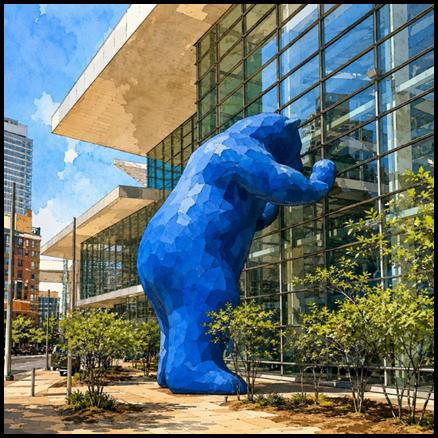
The Colorado Convention
Center itself remains an excellent facility, complete with the enormous blue
bear peering through its glass wall. Officially
titled “I See What You Mean,” the 40-foot bear has been watching convention
visitors since 2005 and has become the building’s unofficial mascot.
Unfortunately, during my
more recent visits, the bear was about the only part of the downtown experience
that still seemed cheerful.
CEDIA returned to Denver for
a run of shows just as downtown was enduring a remarkably difficult period. The pandemic had emptied offices and reduced
pedestrian traffic. Stores and
restaurants were struggling. Homelessness
had become increasingly visible. Then
Denver began tearing apart the very street that was supposed to connect the
convention center with the rest of downtown.
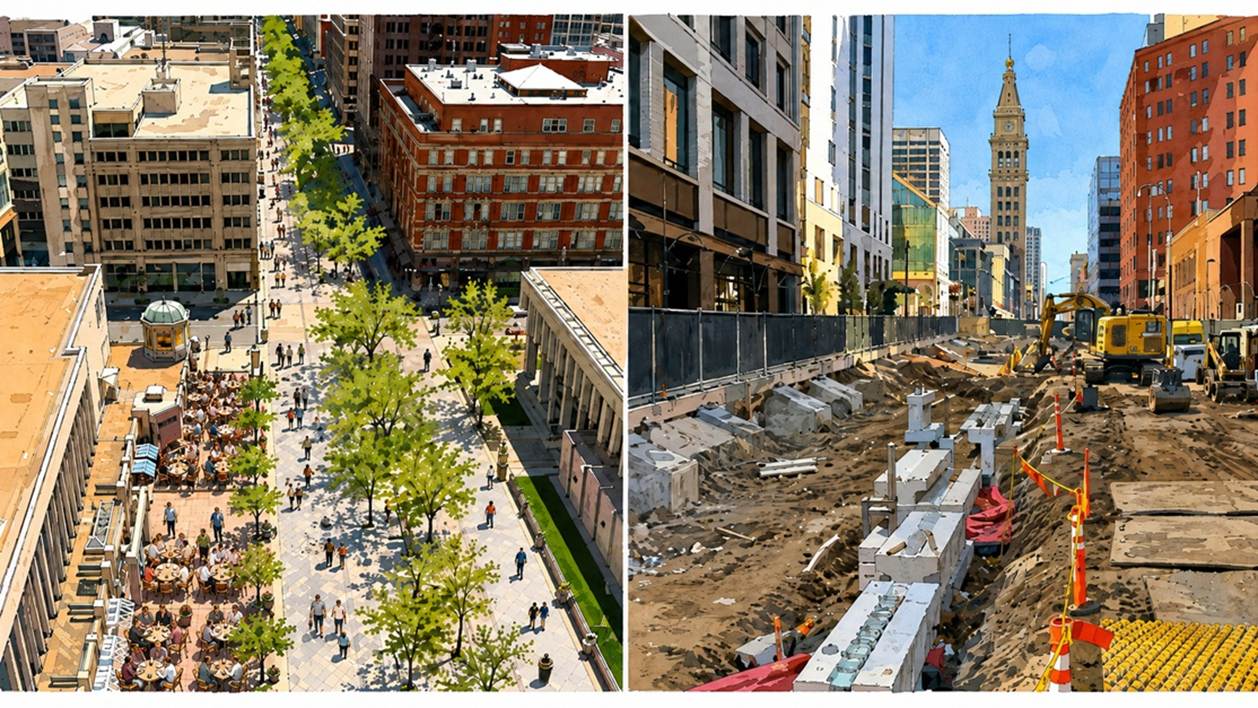
Downtown Denver Before and During Construction
The reconstruction of 16th
Street began in 2022. For convention
visitors, the result was block after block of fencing, excavators, detours,
narrowed pedestrian paths and businesses that were technically open but often
difficult to reach.
Local reporting in 2023
described a corridor where construction had driven away customers while
homelessness, drug use and crime remained persistent concerns. January foot traffic was reported at about
200,000 visitors, compared with approximately 350,000 during the same month in
2019.
From a visitor’s
perspective, it felt worse than those statistics suggest.
Walking from the convention
center toward the remaining shops meant navigating construction barriers while
encountering more people living on the street than the area seemed capable of
humanely supporting. Some entrances were
blocked or difficult to find. Several
familiar businesses were gone. The walk
that had once been a pleasant conclusion to the conference day or an easy break
for a streetside lunch became something to avoid.
I want to be clear about
that last point. People experiencing
homelessness are not an urban inconvenience to be swept out of sight or
arrested because convention visitors find their presence uncomfortable. They are human beings who need housing,
treatment, sanitation and support.
But compassion does not
require pretending that leaving people to sleep, struggle and sometimes
deteriorate on a commercial street is a successful public policy. It is neither humane for them nor workable
for the residents, employees, merchants and visitors attempting to use the same
public space. If there was money for the
construction some of it should have been spent helping these people.
Denver appears to have made
some progress. The Metro Denver Homeless
Initiative reported that the region’s 2026 homeless count declined 8 percent
from the prior year, while the number of people sleeping outdoors declined 21
percent. That is a meaningful
improvement, although 1,703 people were still counted in unsheltered locations
across the region.
Three Years to Repair a
Street – And Destroy a Reputation
Denver says the physical
reconstruction is finally over.
The approximately $175
million project replaced deteriorating infrastructure, widened sidewalks,
created new public spaces and expanded the street’s tree canopy to more than
200 trees. The entire 1.25-mile corridor
reopened in October 2025, and the shuttle – now renamed the 16th Street FreeRide – resumed service between Union Station and Civic
Center.
That means my September trip
will be my first opportunity to see the supposedly repaired version.
Perhaps it will be beautiful
again. Perhaps the new trees, patios and
gathering spaces will eventually restore some of the atmosphere I remember. There are signs that people are returning,
although downtown’s office vacancy rate remained around 29 percent during the
first quarter of 2026.
Infrastructure can be
replaced more easily than habits, however.
A visitor who encounters a bad downtown experience once may forgive it. Someone who experiences it year after year
eventually stops venturing outside the convention center.
A city can spend three years
rebuilding a street and considerably longer rebuilding the expectation that
there will be something worth finding at the end of it.
The Last CEDIA in Denver
CEDIA Expo returns to Denver
September 1–4, but this will be its last Denver event for at least the
foreseeable future. Beginning in 2027,
the show starts a national rotation: Las Vegas in 2027, Orlando in 2028, Las
Vegas again in 2029 and Dallas in 2030.
CEDIA’s organizers are not
publicly blaming Denver. They describe
the rotation as a way to reach new markets, make travel easier for attendees in
different regions and bring fresh energy to the event. That is perfectly plausible and probably
commercially sensible.
Nor is Denver’s overall
convention business collapsing. In fact,
the Colorado Convention Center reported a record 87 convention-center groups
and more than 276,000 attendees in 2025.
So I cannot honestly claim that CEDIA is leaving because
downtown Denver failed it.
I can say that Denver
squandered much of the goodwill it once enjoyed with longtime attendees like me. It allowed the experience surrounding an
otherwise excellent convention center to deteriorate, then subjected visitors
and businesses to years of disruptive reconstruction, obstructed sidewalks,
persistent solicitation and a downtown environment that often felt actively
unwelcoming. Whatever the project’s
eventual benefits, the process was a miserable failure from a visitor’s
perspective.
The timing is painfully
ironic. Just as Denver declares the
street restored, the show that repeatedly brought me there is preparing to
leave.
You Can Rebuild the
Street, But Not the Memory
When I return in September,
I will walk down 16th Street again.
I hope the shuttle is
running. I hope the new trees are
thriving. I hope shops and restaurants
have returned and that the people who once had nowhere else to go have been
offered something better than another order to move along.
I would genuinely like
Denver to prove my recent impressions obsolete.
But even if the
reconstruction is successful, I suspect the visit will feel less like a reunion
and more like saying goodbye. The
downtown I remember was not merely a collection of granite pavers, trees and
storefronts. It was the feeling that
whenever you stepped away from business inside the convention center – for
lunch, a drink or simply a walk – an inviting city was waiting outside.
That Denver may eventually
exist again for a new generation of visitors.
For me, this September will
probably be one last attempt to find a place that survives more clearly in
memory than it does on the map.
You can repair the pavement. You can rename the shuttle. You can plant new trees.
But sometimes, you really
can’t go home again.

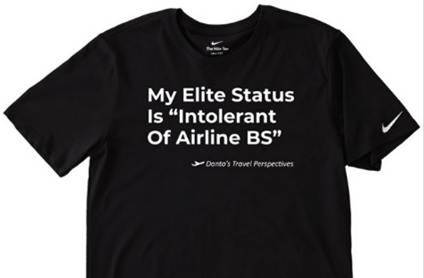
After
decades of candid travel commentary – from loyalty program “magic tricks” to
hotel check-in roulette – I’ve decided to turn some of that honesty into
apparel. These aren’t novelty shirts;
they’re the exact truths every road warrior wishes they could say out
loud. Whether you’re quietly muttering “My
loyalty points devalued while you read this shirt” or admitting “If
delays build character then I’m the whole movie’s
cast” you’ll find plenty of familiar sentiments… and more. Everything is
produced by a reputable outfit, with black tees that work under a sport jacket
plus hoodies and wicking travel gear for life on the road. The site also has my
honest and snarky takes on technology trade shows. Take a look at Tinyurl.com/TechAndTravelWear. Even if you’re not buying
they’re fun to read and commiserate – and if you do buy something, maybe I’ll
break even. If you want a style you
don’t see, just email me and I’ll add it.
This article was written by David Danto and contains solely his own, personal
opinions.
All image and links provided above as reference under
prevailing fair use statutes.
Copyright 2026 David Danto
++++++++
As always, feel free to write and comment, question or
disagree. Hearing from the traveling
community is always a highlight for me.
Thanks!