



David J. Danto
Travel thoughts in my
own, personal opinion
eMail: ddanto@IMCCA.org Follow Industry News: @NJDavidD on 

How Will An AI Bubble Affect Travel – March 2026
I’ve spent most of my life watching the economy 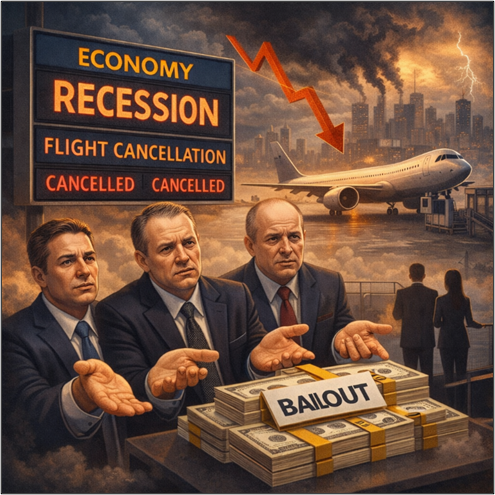 from airport gates. When things go bad, you see it
first in the departure boards and the empty seats. During the sub-prime crisis
and Great Recession, airlines merged, slipped in and out of bankruptcy, trimmed
routes, and quietly made travel more miserable while insisting they had no
choice. Capacity went down, fees went up, and somehow travelers paid more for
less.
from airport gates. When things go bad, you see it
first in the departure boards and the empty seats. During the sub-prime crisis
and Great Recession, airlines merged, slipped in and out of bankruptcy, trimmed
routes, and quietly made travel more miserable while insisting they had no
choice. Capacity went down, fees went up, and somehow travelers paid more for
less.
Then the pandemic arrived and did not just dent air travel -
it erased it. Planes were parked in the desert, terminals became ghost towns,
and whole fleets sat idle while governments rushed in with bailout packages to
keep the industry from collapsing completely. Once again, the pattern was
familiar: save the airlines now, worry about the bill later.
My friend and fellow travel curmudgeon Joe Brancatelli has a line he uses all the time: airlines are capitalists
during good times and socialists during bad times. They keep the profits when
the cabins are full, and when the economy tanks, taxpayers are suddenly
partners in the business. Looking back at the last couple of crises, it is hard
to argue with him.
Lately I am getting the uncomfortable sense that the canary
in our travel cave is not just sleeping. The whole Artificial Intelligence-driven
economy (AI) looks like it’s headed for trouble that may grow to affect
multiple sectors – including travel.
To be clear, I am not an AI skeptic in the sense of thinking
it will disappear. These tools are already changing how we write, code,
research, and communicate. Every few months they noticeably improve.
What worries me is the financial scaffolding being lashed
onto that progress. Enormous commitments for chips, power, and data centers are
being made on the assumption that AI usage and revenue will explode fast enough
to justify them. A lot of it boils down to elaborate IOUs between chipmakers,
cloud providers, and AI labs - future capacity sold to fund even more capacity.
It only works if almost everything goes right.

We have seen that pattern before in other bubbles. The
technology or asset underneath is not fake, but the expectations sit on top of
it like an overloaded carry-on that really should have been checked. At some
point reality steps in. Growth slows, costs bite harder than expected, and
suddenly all those confident projections start to look optimistic rather than
inevitable.
With today’s AI, some of the largest players are talking
about spending hundreds of billions of dollars on chips and data centers over
the next decade, even as their own revenue projections sit far below those
investment numbers. OpenAI is the current poster child: after its CEO floated
the idea of as much as 1.4 trillion dollars in infrastructure commitments, the
company is now telling investors it expects to spend much less – roughly 600
billion dollars – on compute through 2030, while projecting a little over 280
billion dollars in total revenue over the same period – and acknowledging that
the cost of running its models has already surged enough to squeeze margins.
At the same time, outside analysts estimate that big-tech AI
infrastructure spending could reach the mid-hundreds of billions of dollars per
year as this boom moves into what they politely call a “more dangerous phase,”
with exponentially rising investments and growing reliance on outside capital.
All of that is being financed through intricate arrangements (essentially,
modern IOUs) between chipmakers, cloud providers, and AI firms, leaning heavily
on future demand that has not fully materialized yet. The much-publicized “100 billion”
Nvidia and OpenAI partnership is another example – announced with great fanfare
and later walked back as something less concrete – which only reinforces how
often headline numbers in this space turn out to be more aspirational than
real.
Meta (Facebook) also announced a deal with AMD this week that
fits that pattern perfectly. The company has just agreed to buy up to six
gigawatts’ worth of AI compute over five years – a load comparable to the power
used by roughly five million homes – in a deal that could be worth between 60
and 100 billion dollars, and gives Meta the option to acquire up to 10 percent
of AMD’s stock. In plain terms, Meta is promising to buy an enormous amount of
future GPU capacity and, in return, gets a chance to profit if AMD’s share
price soars. The structure is classic funny money: enormous chip purchases for
data centers that have not been built yet, funded partly by equity warrants and
future share-price milestones instead of cash on the barrelhead. This is Meta
we are talking about – the company that announced and then killed its Portal
devices, walked back its Metaverse ambitions, and watched its Diem
cryptocurrency project die on the vine. Can one really believe all of these
power-hungry data centers will be built and fully utilized on the timelines
implied by these deals? That, my friends, is precisely what a bubble looks like
– a stack of expectations and commitments that only works if growth stays
nearly perfect.

A recent, popular
Internet meme - author unknown
So yes, I do think we are in an AI bubble. I do not expect it
to explode overnight. It is more likely to deflate. Some projects will be
cancelled. Some eye-popping valuations will settle back to earth. The winners
will be the firms whose AI businesses are grounded in real customers, real
usage, and real economics, not just press releases and investor decks. The
losers will be everyone else.
Where this connects back to travel is simple: when overbuilt
sectors start to wobble, discretionary spending takes a hit, and air travel is
one of the first places that shows up. If the AI IOUs get called in and
discovered to be stacked like worthless dominoes, you can expect corporate
travel budgets to tighten, and airlines to ask for us to bail them out again.
For now, the terminals are busy, the planes are over-full,
and the airport lounges are overflowing with people whose jobs are at least
partly touched by AI. The technology is not going anywhere. The question is
whether the investment frenzy around it can land safely, or whether we are in
for yet another rough patch where the rest of us pay for someone else’s
overconfidence – including every time we need to travel. If history is any
guide, when the AI bubble finally hits turbulence, the airlines will have their
hands out again and we will be left paying their bills at the same time we are
struggling to pay our own.

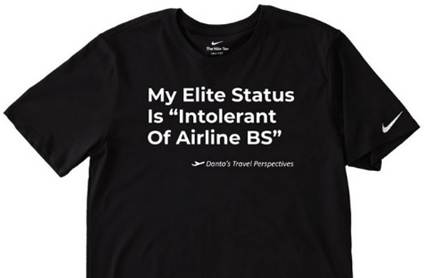 After decades of candid travel
commentary – from loyalty program “magic tricks” to hotel check-in roulette –
I’ve decided to turn some of that honesty into apparel. These aren’t novelty shirts; they’re the
exact truths every road warrior wishes they could say out loud. Whether you’re quietly muttering “My
loyalty points devalued while you read this shirt” or admitting “If
delays build character then I’m the whole movie’s
cast” you’ll find plenty of familiar sentiments… and more. Everything is
produced by a reputable outfit, with black tees that work under a sport jacket
plus hoodies and wicking travel gear for life on the road. The site also has my
honest and snarky takes on technology trade shows. Take a look at Tinyurl.com/TechAndTravelWear. Even if you’re not buying
they’re fun to read and commiserate – and if you do buy something, maybe I’ll
break even. If you want a style you don’t
see, just email me and I’ll add it.
After decades of candid travel
commentary – from loyalty program “magic tricks” to hotel check-in roulette –
I’ve decided to turn some of that honesty into apparel. These aren’t novelty shirts; they’re the
exact truths every road warrior wishes they could say out loud. Whether you’re quietly muttering “My
loyalty points devalued while you read this shirt” or admitting “If
delays build character then I’m the whole movie’s
cast” you’ll find plenty of familiar sentiments… and more. Everything is
produced by a reputable outfit, with black tees that work under a sport jacket
plus hoodies and wicking travel gear for life on the road. The site also has my
honest and snarky takes on technology trade shows. Take a look at Tinyurl.com/TechAndTravelWear. Even if you’re not buying
they’re fun to read and commiserate – and if you do buy something, maybe I’ll
break even. If you want a style you don’t
see, just email me and I’ll add it.
This article was written by David Danto and contains solely his own, personal
opinions.
All image and links provided above as reference under
prevailing fair use statutes.
Copyright 2026 David Danto
++++++++
As always, feel free to write and comment, question or
disagree. Hearing from the traveling
community is always a highlight for me.
Thanks!